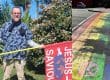


East London activist Sikhander Coopoo attended the Equality Court hearing on Monday 26 May against Gqeberha shop owner Dawood Lagardien, who in 2023 sought to bar LGBTQ+ people from his store. The case was brought by the South African Human Rights Commission (SAHRC) against Lagardien over his discriminatory sign stating: “LGBTQ NOT WELCOME. SAVE OUR CHILDREN” and an anti-LGBTQ+ WhatsApp group that he created.
As I sat outside East London High Court on Monday morning, I felt a mix of uncertainty and hope. However, by 9 am, that initial unease was eased by the presence of comrades.
Humxn rights organisations and queer activists gathered with a deep, shared commitment to solidarity. We were there for the South African Human Rights Commission, for ourselves, and for every queer individual who has ever been made to feel unwelcome in this world.
Yet the tension was undeniable. Vehicles branded Lagardi Security made their presence known. A show of support, or a subtle tactic of intimidation? No one said it out loud, but we felt the shift in the air. Later I was told that some of the activists noticed people taking their photos. We don’t know who, but we do know that being watched in those ways is never just passive. It’s a warning, a reminder of the risks we take by standing in the light.
Inside, the courtroom was packed. The final row was visibly occupied by Lagardien’s supporters, their energy distinct from ours.
As the proceedings began, it became painfully obvious that Lagardien’s legal team was not here to confront the injustice at hand; they were focused on sidestepping it.
Their argument relied on technicalities, claiming that the issue was no longer relevant, that the signage had been taken down, the WhatsApp group had been erased, and that no formal affidavits were presented by those who had been directly affected. It was disheartening to witness such a lack of accountability for the very real harm experienced by individuals.
In other words: No harm, no foul. As if the harm hadn’t been done the moment queer bodies were denied dignity and safety. As if structural violence can be undone with the removal of a hateful sign and a few taps on a phone.
Their strategy seemed aimed at using the legal procedure to distract from the real issues at hand, attempting to make the court overlook the truth. They argued that this was merely an academic concern, better suited for the Appeal Court. However, for us, those who endure the repercussions of hate speech, this is far from theoretical. This is about our very survival.
Thankfully, the SAHRC’s legal representative cut through that noise. This case isn’t about restricting freedom of religion. It’s about equality. It’s about the Promotion of Equality and Prevention of Unfair Discrimination Act. No one’s faith was criminalised. And if they felt it was, the proper avenue was available, a complaint to the SAHRC, which never came.
We were reminded about the heart-breaking incident involving a same-sex couple who was “politely asked to leave” Lagardien’s business. Such a gentle phrase masks the painful reality of exclusion. The SAHRC emphasised to the court, and to all of us, the Commission is here to protect those whose humxn rights have been violated. This is what true justice should embody.
The judge’s response stirred something in me. With quiet authority, she said: “I want to hear everything, then make a decision. This matter must be settled once and for all.”
Her words carried a deep sense of dignity, embracing each of us and offering the legal system a chance to align with the humxnity we are all striving to achieve.
The case was postponed until 28 July 2025. Between now and then, we must keep doing what we have always done: learn, organise, resist.
But this day held a heavier weight. It marks 100 days since Imam Muhsin Hendricks was brutally assassinated in Gqeberha, the very city where Lagardien’s signage poisoned the air. Imam Hendricks wasn’t just a religious leader. He was a beacon of compassion in a faith so often used to silence queer Muslims. He dared to imagine a compassion-centred Islam that embraced all of us. And he lived that truth with courage and tenderness.
If this case was about religion and should Imam Hendricks have had the opportunity to be a witness, he would have dismantled, with grace and scholarship, a lie that Islam mandates exclusion. He would have shown us that faith, compassion and queer love are not opposites. That all our lives are sacred.
That’s why this case matters. Because hate speech, even if falsely disguised by religion, cannot be protected if it harms others. The SAHRC’s fight is our fight, a reminder that queer people are not asking for tolerance. We are demanding justice.
For every LGBTQIA+ person who has ever been told they are less than others, today was a step toward something better. It’s a commitment to ensuring that our struggles and pain are recognised and valued, not simply brushed aside as if they were just theoretical concerns.
This is an important reminder to politicians, preachers, and public figures that words carry weight and impact lives. When hate is incited, it will be met with challenge, and there will be consequences to face.
We are here, witnessing the pain, sharing in the grief, and finding our strength to rise. And as Imam Hendricks taught us, “I think God is not homophobic. We are”.
Sikhander Coopoo is a black, queer, Muslim intersectional feminist with backgrounds in gender, pedagogy and local governance. He is a social justice and humxn rights activist at heart. Sikhander serves on the Gender and Sexuality Alliance of East London committee and writes in his own capacity.