

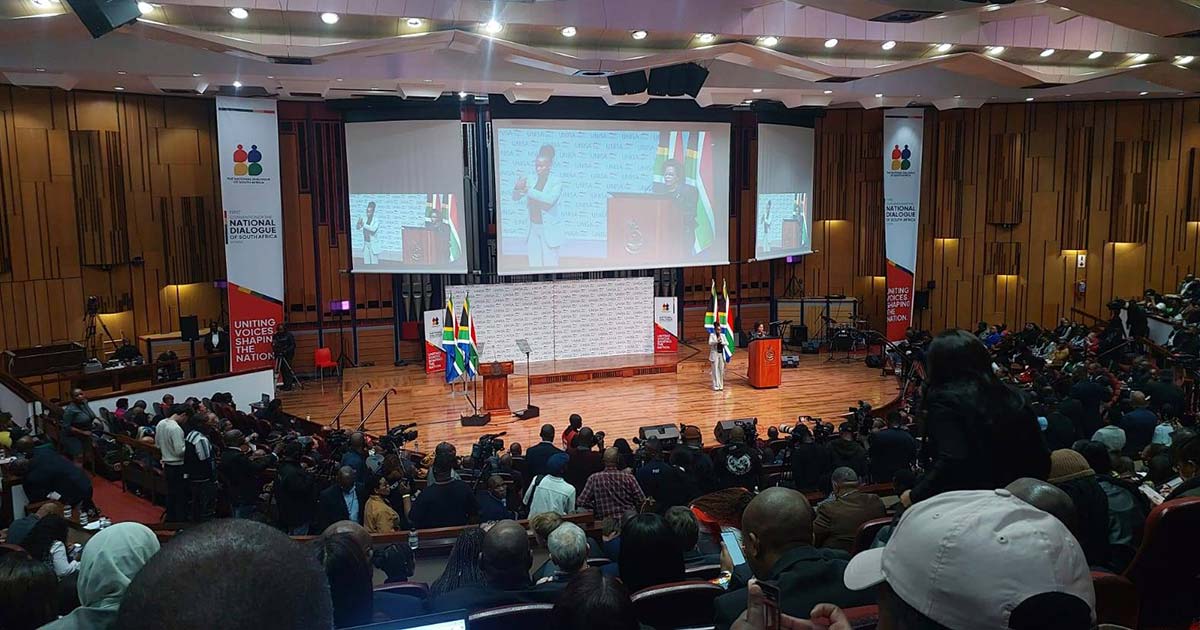
The First National Convention of the National Dialogue took place over the weekend (15–16 August 2025) at the University of South Africa in Tshwane, drawing more than 1 000 delegates from over 200 organisations across the country, including several LGBTIQ+ groups.
Convened by President Cyril Ramaphosa, the two-day event launched a nationwide process of public dialogues aimed at uniting South Africans around a common vision for the country’s future.
The convention featured representatives from civil society, traditional leaders, youth and women’s movements, faith-based groups, business, labour, and LGBTQ+ organisations such as Access Chapter 2, IAM, Iranti, MambaOnline and OUT LGBT Well-being.
Opening the gathering on Friday, Ramaphosa stressed that the National Dialogue was “not a partisan platform, but a national platform.” He described it as a space where South Africans could share their hopes, frustrations, and solutions openly.
Significantly, the President highlighted the continued marginalisation of queer South Africans:
“Why, when we have a Bill of Rights, are LGBTQI+ people still discriminated against, stigmatised and harassed?” Ramaphosa asked, noting that equality on paper has yet to translate into equality in everyday life.
LGBTQ+ and Intersex Voices
Importantly, the LGBTQIA+ community was one of the 22 sectors identified at the event to ensure inclusivity for all groups in future convenings.
Queer activists welcomed the recognition but emphasised that discrimination remains a lived reality. Peace Maquba of Iranti, speaking for the intersex community, described how children are still subjected to harmful medical interventions at birth and face bullying and exclusion in schools.
“Some intersex people’s bodies develop differently and then they go through bullying, then they drop out of school because of the harmful behaviours that they experience,” Maquba explained.
Iranti also warned against the erasure of lesbian women in how gender-based violence (GBV) is reported. Programmes manager Ntuthuzo Ndzomo said many lesbians fear reporting cases because authorities are often quick to judge them. He added that GBV cases are more likely to gain traction in the mainstream when they involve middle-class black or white women, leaving working-class queer women especially vulnerable.
Ndzomo further noted that Iranti’s decision to participate was partly in response to the much-publicised withdrawal of several legacy foundations from the convention. “We felt it was important to participate and show that these foundations do not even have members,” he said.
Foundations’ Withdrawal
Seven well-known foundations established by former ANC leaders and liberation icons, including the Steve Biko Foundation, the Desmond and Leah Tutu Legacy Foundation, and the Thabo Mbeki Foundation, withdrew from the process ahead of the weekend.
In a joint statement, the foundations said:
“It is with deep regret, but with unwavering conviction, that we have resolved to withdraw our participation due to our belief that core principles meant to underpin the whole National Dialogue have been violated in the rush to host a gathering on 15 August. Dialogue cannot be built on haste.”
The statement raised concerns about the process shifting from a citizen-led initiative to one controlled by government, a lack of resources and operational readiness, and the risk that the event would become “more performance than participation.” The foundations proposed rescheduling the dialogue to after 15 October 2025 to ensure adequate preparation and credibility.
Heated Exchanges
Delegates engaged in robust discussions on issues including poverty, unemployment, corruption, gender-based violence, and healthcare. But by the second day, frustrations surfaced. Many participants accused facilitators of misrepresenting their input during feedback sessions.
“This is not what we said!” one woman shouted, interrupting the proceedings. Nomalanga Ngwenya of Sonke Gender Justice added: “Our voices are not there. The deliberations were diluted and I would not be comfortable with that being the report that is published on our behalf.”
Another person pointed out that in the report, children and people living with disabilities had been left out.
Further tensions arose when Deputy President Paul Mashatile, who stood in for Ramaphosa on Saturday, briefly left the room, a move some delegates interpreted as a sign of disrespect.
Next Steps
Despite the withdrawals and frustrations, the convention marked the beginning of a broader dialogue process that will unfold in all nine provinces over the next six to eight months. A second National Convention may take place in early 2026 to reflect on the outcomes.
For South Africa’s LGBTQ+ community, the event was a reminder that their struggles must remain central to the national conversation.
Ramaphosa’s words were welcomed as recognition, but activists stressed that only sustained action will ensure that queer South Africans live free from discrimination.


One Comment
I’m one of the activists that attented the dialogue and I feel like as Transgender people we are not included in the space , number one the issue on legal gender recognition and access to gender affirmation treatment.