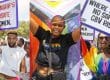


Thousands took to the streets of Cape Town on Saturday, 27 September, in a mass march calling for an end to Israel’s occupation and in solidarity with the people of Palestine.
The march, led by the Muslim Judicial Council (MJC), the Al-Quds Foundation South Africa, and the Palestinian Solidarity Campaign (PSC), drew a broad coalition of organisations, from political parties to faith-based groups.
But while the demonstration showcased unity around Palestinian liberation, it also exposed sharp tensions over the inclusion of organisations with a history of anti-LGBTQ+ rhetoric.
Queer Groups Sound the Alarm
Ahead of the march, civil society organisation iZibuko Zethu released a statement warning that the credibility of the movement was being undermined by the participation of groups such as the Muslim Judicial Council (MJC), PAGAD, Al-Jamaah, and Umkhonto weSizwe (MK).
“These positions are not abstract,” the group argued, referencing the MJC’s 2022 fatwa declaring Muslims who engage in same-sex acts outside the fold of Islam, and PAGAD member Haroon Orrie’s 2023 call for the death of LGBTQ+ people.
“They create unsafe conditions for queer people in South Africa. If liberation excludes some of us, then it is not liberation at all.”
The statement cautioned that solidarity must not come at the expense of queer lives, insisting: “To partner with organisations that promote hate is not decolonial, it is a betrayal of the very principles of justice.”
Students Join the Critique
The Palestine Solidarity Coalition at the University of the Western Cape (PSCUWC) echoed these concerns in a statement issued the day before the march
While endorsing the mobilisation, the student group stressed their unease with the queerphobic actions of some participating organisations.
Quoting queer Muslim Imam Muhsin Hendricks, who was assassinated in February, they emphasised that their critique was “not confrontational, it’s care-frontational.”
On UWC’s campus, the Palestinian and Pride flags continue to fly side by side, which the coalition says symbolises the “intersected struggles” of queer and Palestinian liberation.
Looking Ahead
Despite these tensions, both iZibuko Zethu and the PSCUWC are expected to meet in the coming weeks to discuss how solidarity spaces can be made safer and more inclusive.
Activists say this dialogue will be crucial in ensuring that queer voices are not sidelined in the pursuit of Palestinian liberation.
For now, the march has amplified both the urgency of ending the occupation in Palestine and the need to confront queerphobia within South Africa’s solidarity movements.
As iZibuko Zethu concluded in their statement: “We will not abandon Palestine. But neither will we abandon queer lives. Justice must hold us all. Anything less is betrayal.”