

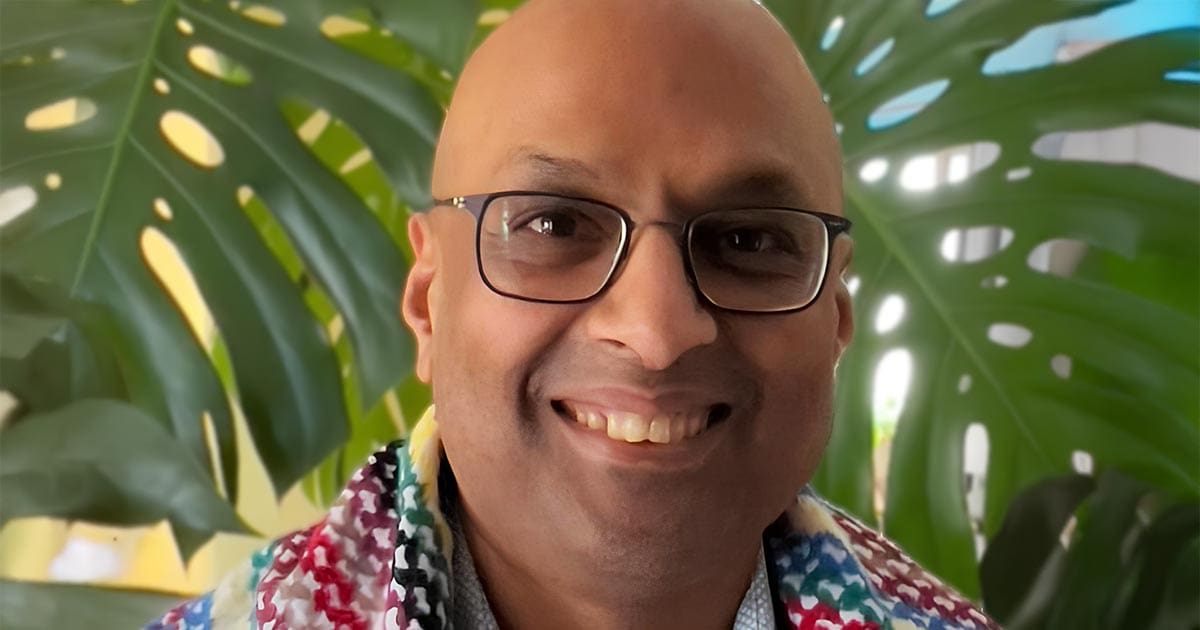
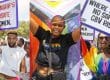
In this opinion piece, activist Sikhander Coopoo, pictured above, challenges the spread of misinformation in queer spaces and reflects on the dangers of selective solidarity.
I’ve been queer long enough to recognise what it feels like when someone weaponises your identity against you. When your existence is used not to protect you, but to justify something else entirely. A war, a border, a hierarchy. It’s a particular kind of violence, the kind that smiles at you while it does its work.
That’s why I need to talk about what’s happening in South African queer spaces right now. Some of us, people who know marginalisation intimately, who have fought hard for the right to exist, are now repeating the very logics that have been used to oppress us. And we need to do better.
Let’s start with one of the most persistent lies. You’ve probably seen it. The claim that Hamas throws gay people off rooftops. I’ve watched this story spread through WhatsApp groups, Facebook threads, and even dinner conversations among queer people who should know to check their sources.
Here’s what the evidence actually shows. The documented cases of gay men being thrown from buildings took place in ISIS-controlled areas of Syria and Iraq between 2014 and 2015, particularly in Mosul. These were real, horrific atrocities, extensively documented by human rights organisations. But they were carried out by ISIS, not Hamas and not the Palestinian Authority.
According to a 2018 report2018 report by the Immigration and Refugee Board of Canada, drawing on sources such as Haaretz and The New York Times, there have been isolated incidents of violence against LGBTQIA+ people in the Palestinian territories.
One widely reported example is a 2016 case in which Hamas killed a commander accused, among other things, of being gay. This is serious and warrants careful, good-faith engagement. Yet there is no evidence of systematic “roof-throwing” as an official Palestinian policy. Conflating ISIS with Palestinian governance is not an honest mistake. It is propaganda. And when we repeat it, we become part of its distribution network.
Meanwhile, the bombs that have killed more than 72,000 Palestinians in Gaza since October 2023 do not check anyone’s sexuality before they fall. As UNICEF Executive Director Catherine Russell notes, 64,000 children have been killed or maimed across the Gaza Strip in the past two years, including at least 1,000 babies. Queer Palestinians are dying in that rubble alongside their families and communities, not because they are queer, but because they are Palestinian.
This is where pinkwashing enters, and where things get more insidious.
Pinkwashing refers to Israel’s strategic use of LGBTQIA+ rights to project a progressive image while diverting attention from its occupation and apartheid policies. Tel Aviv is promoted as a “gay haven,” and Israeli tourism campaigns specifically target queer Europeans and Americans. As scholar Jasbir Puar notes, this strategy works partly because it depends on depicting Palestinians as sexually regressive – backward, dangerous, and undeserving of solidarity.
For South African queers, this should ring alarm bells we recognise from our own history. Under apartheid, Black South Africans were labelled “uncivilised” to justify their oppression. We know how claims about “civilisation” are weaponised. So, when someone says Palestinians don’t deserve solidarity because of how their society treats queer people, they are drawing on the same colonial logic, just dressed in a rainbow flag.
Renaldo Gouws, a Freedom Front Plus politician, recently ran a fundraising campaign to send a queer activist to Gaza, framing it as a challenge to queer pro-Palestinian solidarity. His stunt rests on a cruel, cynical premise: that empathy is contingent on shared values, and that you can only oppose a genocide if you agree with every aspect of the culture being targeted. By this logic, no one should have opposed apartheid until Black South Africans had their queer politics “in order.”
Other currents are running through our community that we speak about less openly. In South African queer spaces, both Christian nationalism and Hindutva (Hindu nationalist ideology) have gained footholds. This may seem contradictory, but both offer a framework of “traditional values” that can be repackaged as defending South African culture from “foreign” influences. Islamophobia is often the gateway. The enemy becomes the Muslim Other, and suddenly some queers find themselves aligned with movements that have spent decades trying to erase us.
The Family Policy Institute, Pastor Oscar Bougart, Pastor Angus Buchan, and similar groups have consistently opposed LGBTQ+ rights, abortion, and comprehensive sexuality education in this country. Likewise, Hindutva organisations in India have opposed the decriminalisation of homosexuality and the recognition of transgender rights. These are not our allies. Yet when their Islamophobic talking points are repackaged in queer rhetoric about “safety,” some of us don’t recognise the company we’re keeping.
And then there is the classism and racism within our own spaces that queer activist Sibonelo Ncanana-Trower has called out so precisely: “ignorant, racist, and classist thinking dressed up as political commentary.”
A 2022 study on learning in South African social movements illustrates this clearly. Sibongile Shabalala describes middle-class activists who “want to dictate and influence what really needs to happen on the ground”, people who have never lived the situation, yet feel entitled to tell others how to navigate it. We see the same pattern in queer spaces. We mock migrants and refugees and reproduce xenophobic narratives that echo the logic of “Operation Dudula.” We reduce poor communities to stereotypes, and we call it politics.
I want to end with Imam Muhsin Hendricks, South Africa’s first openly gay imam, who was assassinated in February 2025. He spent his life refusing to fragment either his identity or his solidarity. Through the Al-Ghurbaah Foundation, he built safe, affirming spaces for queer Muslims. In November 2024, he hosted a “Shabbat Against Genocide” at his mosque.
Married to a Hindu man, he challenged Islamophobia and homophobia in the same breath, knowing that you cannot fight one form of dehumanisation while practising another. He was murdered here in South Africa, by organised hatred, not abroad, not by some distant enemy we can blame.
His life answers the question of what solidarity really looks like. It is not a performance, and it is not conditional. True solidarity does not first ask whether the people being bombed share your values before deciding if their lives matter.
As the Palestinian queer organisation alQaws puts it, there is no “pink door” in the apartheid wall. Queer Palestinians are not choosing between their queerness and their Palestinianness. They are fighting for liberation as whole, indivisible people.
So are we. Or we should be.
We cannot build our freedom on the dehumanisation of others. That’s not liberation. That’s just a new arrangement of the same old cruelty.
Sikhander Coopoo is a black, queer, Muslim intersectional feminist with backgrounds in gender, pedagogy and local governance. He is a social justice and humxn rights activist at heart. Sikhander serves on the Gender and Sexuality Alliance of East London committee and writes in his own capacity.

10 Comments
Another excellent article.
❤️🏳️🌈🇿🇦🇵🇸🏳️⚧️
Brilliant. Thank you for speaking so loudly. Powerful stuff
Clear and as usual straight to the point..reading your articles feels like a masterclass in clarity and a reminder of what we need to do better in.
Great article.
Brilliantly articulated. Thank you!
Told it like it is: great piece.
Has the murderer(s) of Imam Muhsin Hendricks been identified?
I love how you really put my feelings into words! Well written article! Thank you
Oh those wonderful people in Hamas who believe in freedom and equality for all – link to unwatch.org