

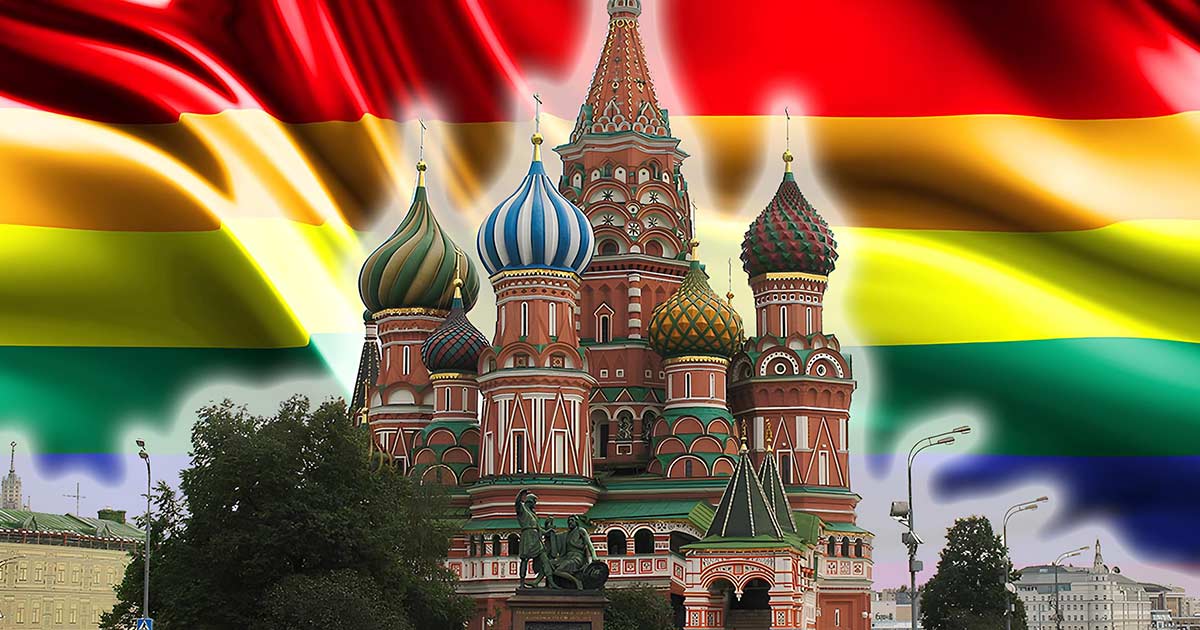
Russia’s ongoing crackdown on LGBTI+ rights has escalated further, with a court designating a leading queer advocacy group, the Russian LGBT Network, an “extremist organisation” and banning its activities nationwide.
According to Amnesty International, the St Petersburg City Court delivered the verdict following closed hearings requested by the Ministry of Justice.
“For nearly two decades, the Russian LGBT Network has united activists from across the country, provided emergency assistance and produced vital research on discrimination and violence against LGBTI people. Banning it is a major premeditated blow to LGBTI people and their allies,” said Marie Struthers, Amnesty International’s Eastern Europe and Central Asia Director.
The decision comes just two months after similar rulings labelled five other LGBTI+ groups as “extremist organisations”. These include Coming Out in St Petersburg, the LGBT Resource Centre in Yekaterinburg, the Moscow Community Centre for LGBT+ Initiatives, the LGBTI group Irida in Samara, and the LGBTI-themed media project Parni+.
Part of Broader ‘Extremism’ Campaign
This latest move builds on the Russian Supreme Court’s 2023 decision to designate the so-called “International LGBT Movement” as an “extremist organisation”.
That ruling, also made during a closed-door hearing attended only by Justice Ministry representatives, came into effect in January 2024. It added the global LGBTI+ movement to a growing list of more than 100 groups banned for allegedly “inciting social and religious discord”.
“When in November 2023 the Supreme Court banned the non-existent ‘international LGBT movement’ as ‘extremist,’ it was clear that the authorities would not stop there. The designation of the Russian LGBT Network and other organizations as ‘extremist’ are links in the same chain of persecution and injustice by the Russian authorities against LGBTI people,” said Struthers.
Arrests, Sentences and Escalating Repression
Since late 2025, authorities have intensified their crackdown through criminal prosecutions, arrests and fines targeting individuals, private gatherings and media platforms.
In November 2025, a Moscow court convicted 48-year-old businessman Andrei Kotov — who died allegedly by suicide while in custody — of “organising an extremist organisation” because he reportedly ran a travel agency offering LGBTI+ tours.
On 4 December 2025, a court in Ulyanovsk placed three residents under house arrest. Prosecutors charged them with “organising and participating in the activities of an extremist organisation” for hosting closed LGBTI-themed parties and drag shows between January 2024 and December 2025.
On 8 December 2025, a court in Cherkessk sentenced a resident of the Republic of Karachay-Cherkessia to two-and-a-half years’ imprisonment for joining a group chat and posting comments that authorities claimed promoted “non-traditional sexual relations”.
On 18 December 2025, a court sentenced sex educator and LGBTI activist Sasha (Aleksandra) Kazantseva in absentia to nine years’ imprisonment. Authorities accused her of spreading “false information” about the Russian Armed Forces and participating in an “extremist LGBT movement”. By the end of 2025, officials had opened at least 23 criminal cases on “extremism” charges linked to LGBTI activities.
Growing Pressure on Free Expression
In January 2026, drag performer Aleksandr Knyagin fled Russia after authorities placed him on a federal wanted list following a police raid on an LGBTI event in Kirov on 1 November 2025.
On 23 March, a court in Chita, Eastern Siberia, sentenced 23-year-old entrepreneur Tatiana Zorina to four years in a penal colony for “organising the activities of an extremist organisation” at a nightclub she co-owned.
Authorities have also imposed heavy fines to suppress support for LGBT rights. On 16 April, a court in Saratov fined the news agency SaratovBusinessConsulting 500,000 roubles (around US$6,700) for publishing a review of the TV series Heated Rivalry, which authorities deemed to be “LGBT propaganda”.
Amnesty Calls for End to Repression
“Besides criminal prosecutions and administrative fines, we are also witnessing the systematic erasure of LGBTI people from public life, including through censorship and measures targeting cultural institutions, publishers, bookstores, streaming platforms and online spaces,” said Struthers.
Amnesty called on Russian authorities to stop misusing anti-extremism legislation to repress the LGBTI community, reverse discriminatory policies, and uphold the rights to freedom of expression, association and non-discrimination in line with international human rights law.