South Africa is making progress on women’s representation in journalism, but a new regional study shows that men continue to dominate who gets heard, particularly when it comes to power, expertise and LGBTIQ+ issues.
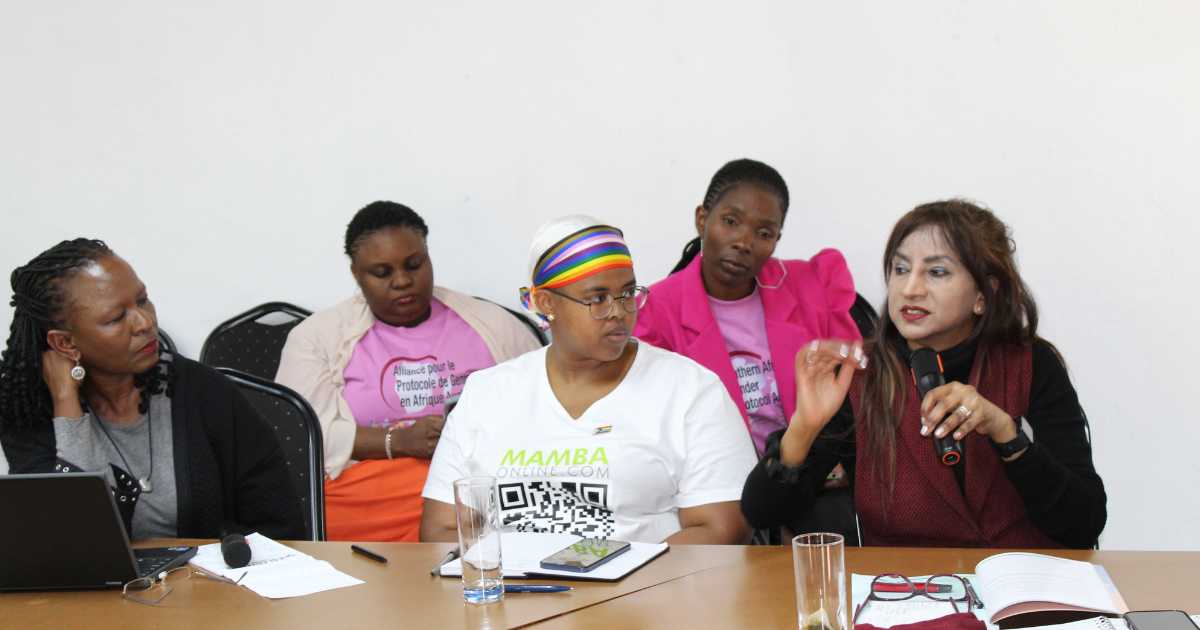
MambaOnline’s Managing Editor, Nompilo Gwala, had the opportunity to attend the launch of the 2026 Gender and Media Progress Study (GMPS) in Johannesburg, GL Cottages, on Monday, 17 August, and even participated in a panel discussion examining the findings and what they mean for media representation across the region.
Conducted by Gender Links and its partners, the study monitored 2,060 news items across more than 200 media outlets in all 16 SADC countries, examining who reports the news, who gets quoted and whose expertise is recognised.
The findings offer a mixed picture. Across the region, women accounted for 29% of news sources, up from 17% in 2003, but no SADC country achieved parity. South Africa performed strongly, with women making up 40% of news sources, second only to Eswatini at 47%.
More women in newsrooms, but not necessarily more women’s voices
Perhaps the study’s most striking finding is the gap between who produces the news and who gets to shape the news narrative.
Women now account for 42% of reporters across the region, up from 31% in 2003. In television and radio, women slightly outnumber men as presenters and anchors. In South Africa, women make up 52% of reporters.
Yet the presence of women journalists has not automatically resulted in more women being quoted.
The study found that women are more likely to be included when sharing personal experiences than when speaking from positions of authority. Across Southern Africa, women accounted for 38% of personal-experience sources, but only 30% of experts and commentators and 24% of spokespersons.
In South Africa, the gap is also visible. Women accounted for 65% of personal-experience sources, but only 42% of spokespersons and 33% of experts and commentators.
In other words, women are being heard, but often as people experiencing an issue rather than as people recognised as having the authority to explain it.
That distinction matters.
As Gender Links Director of Programmes Tabetha Kanengoni noted, increasing the number of women reporting the news does not necessarily mean women have equal influence over editorial decisions or are equally represented among sources.
The LGBTIQ+ news gap
For MambaOnline, one of the most significant findings is what the GMPS reveals about LGBTIQ+ coverage.
Although LGBTIQ+ issues represented 1% or less of the monitored news agenda, women were among the least represented voices in LGBTIQ+-related stories.
Only 13% of sources in LGBTIQ+ stories were women, compared with 86% men. This was the lowest proportion of female sources recorded across the topics monitored, alongside the continuing male dominance of sports coverage.
The finding is particularly important because representation is not simply about whether an LGBTQIA+ story appears in the news. It is also about who gets to define that story.
When coverage about queer communities is dominated by male voices, the media risks reproducing a narrow understanding of LGBTQIA+ experiences, particularly those of lesbian, bisexual, transgender and gender-diverse people.
The study also found that women reporters were strongly represented in LGBTIQ+ coverage. Across the region, women dominated reporting on SRHR, LGBTIQ+ issues, gender equality, and war and conflict.
That creates an interesting contradiction: women may be doing more of the reporting on LGBTIQ+ issues, while women themselves remain significantly underrepresented among the people being quoted.
The distinction between who tells a story and who is allowed to speak within it is therefore critical.
The beats where power still speaks mostly with a male voice
The gender imbalance becomes even more pronounced in areas traditionally associated with political and economic power.
Across the region, women were least visible as sources in politics and government, business and the economy, war and conflict, sports and LGBTIQ+-related coverage. By contrast, women were most visible in stories about gender equality, sexual and reproductive health and gender-based violence.
In South Africa, women accounted for only 31% of sources in business and economy stories, 30% in politics and government and 29% in legal stories.
The pattern suggests that women are still more likely to be called upon when the subject matter is explicitly about gender or lived experience, while men continue to dominate conversations about institutions, money, politics, law and decision-making.
That is not simply a newsroom diversity issue. It shapes how audiences understand who has authority.
A picture still worth a thousand male voices
The imbalance extends beyond written and spoken sources.
Across Southern Africa, 58% of news images mainly featured men and boys, while only 18% mainly featured women and girls. Just under one-quarter showed a balanced mix of genders.
South Africa again performed somewhat better, but still showed a substantial gap: 55% of images mainly featured men and boys, compared with 22% featuring women and girls and 21% showing a gender-balanced mix.
The message is difficult to miss. Even when women are present in the newsroom and increasingly appear in stories, the visual language of news continues to give men greater prominence.
Most news remains gender blind
The study also raises questions about how journalists approach gender itself.
Across SADC, 59% of stories were classified as gender blind, while only 27% were considered gender aware. South Africa performed better, with 37% of stories classified as gender aware, but 57% still remained gender blind.
Gender-aware journalism is not simply about ensuring that a woman appears in a photograph or adding a female source to a story.
It requires journalists and editors to consider how gender shapes the issue being reported, whose experiences are missing and whether existing stereotypes are being reinforced.
This is particularly important for LGBTQIA+ reporting, where issues of gender, sexuality, identity, discrimination and power frequently overlap.