

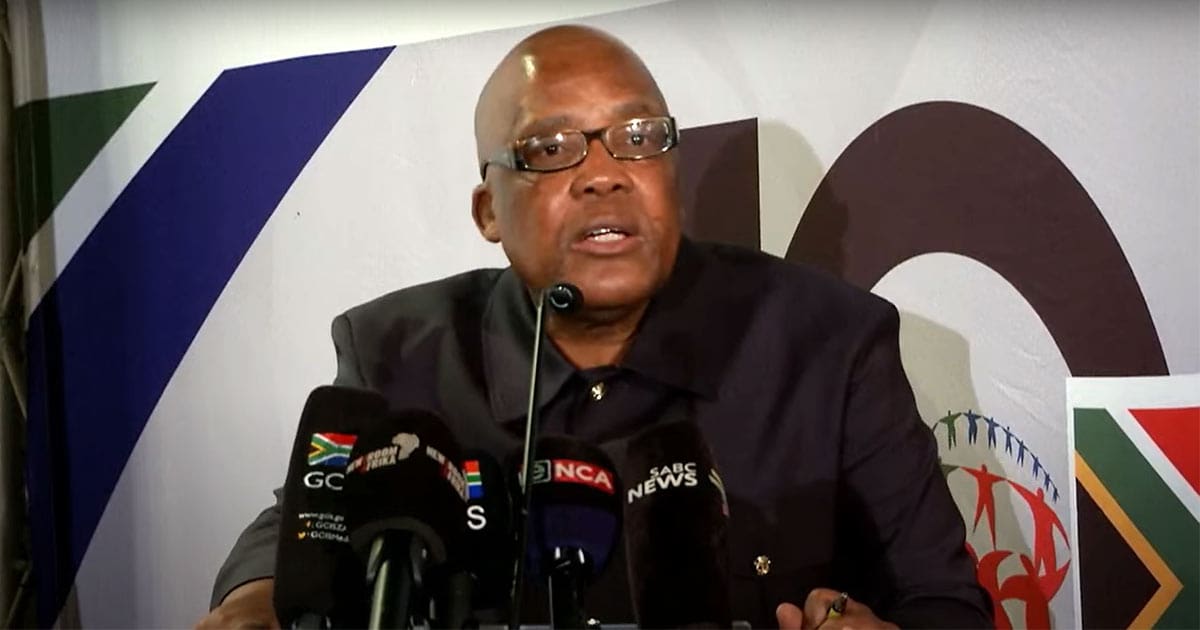
Health Minister Dr Aaron Motsoaledi has sought to downplay the impact of the withdrawal of donor funding by the United States through PEPFAR (President’s Emergency Plan for AIDS Relief) on South Africa’s HIV response.
Speaking at a media briefing on Thursday in Pretoria, the Minister dismissed claims that South Africa’s HIV programme was collapsing, insisting that government-led initiatives are on track and already delivering results.
“It is inconceivable that out of R46.8 billion spent by the country on the HIV/Aids programme, the withdrawal of R7.9 billion by President [Donald] Trump will immediately lead to a collapse of the entire programme,” Motsoaledi said.
“We must put it categorically clear that under no circumstances will we allow this massive work performed over more than a decade to collapse and go up in smoke. If we do so, we will have thrown a massive investment in time, money, and human resources away.”
The briefing appeared to be a response to criticism in the media and among some in the HIV sector that the government has failed to take sufficient action to address the gaps caused by the cuts in funding.
These critics, the clearly frustrated Motsoaledi suggested, were akin to AfriForum in creating unnecessary alarm and spreading misinformation.
Over Half a Million Reached So Far
Motsoaledi reported that government had already reached and initiated 520,700 people living with HIV on treatment — more than 60% of its ambitious target to initiate 1.1 million people not on treatment by the end of 2025.
This has been achieved through a restructured campaign strategy that shifts focus from traditional health facilities to outreach initiatives across villages, workplaces, and community hubs.
“Our focus is in our villages, communities, homes, and on the streets. That’s where the struggle is, and that’s where we are responding,” the Minister said.
To fund the campaign, the Department of Health has prioritised R669 million from the HIV conditional grant — contradicting claims that the programme lacked financial backing.
Inclusion of LGBTQ+ and Key Populations
Amid growing concerns about the continuity of services to highly stigmatised groups such as men who have sex with men (MSM) and trans people, Motsoaledi insisted that these populations are represented within government structures, notably SANAC (South African National AIDS Council). “The LGBTQI+ community is part and parcel of SANAC,” he said.
PEPFAR previously supported 12 specialised clinics that primarily served transgender individuals, MSM, sex workers, and other vulnerable groups.
These clinics served a total of 63,322 clients, with 41,996 based in the City of Johannesburg alone. According to the Minister, all these clients’ medical files have been transferred to nearby public health facilities to ensure continued treatment and care.
“These are not just numbers, but known people with names, addresses and contact details. When PEPFAR-funded clinics were closed, we removed the files of these people from those clinics to the nearest public health facilities,” Motsoaledi explained.
The minister did not announce any government or donor funding to support these now-shuttered clinics that provided targeted and affirming HIV and sexual health services to these groups.
To address concerns that MSM and trans patients would face discrimination and stigmatisation at public health facilities, Motsoaledi said that the health department had embarked on an ambitious effort to train staff to provide inclusive and respectful services.
“The aim is to sensitise people about stigma, because they are dealing with populations they may not normally have helped,” he said, specifically referencing the trans and LGBTQI+ communities.
It remains to be seen how effective this training will be. The Ritshidze initiative, which monitors 450 clinics and community healthcare centres across eight provinces in South Africa, has consistently found that three decades into South Africa’s HIV response, key populations continue to face abuse and discrimination at public health facilities.
Impact on Jobs and Treatment Targets
Motsoaledi acknowledged the unfortunate loss of 8,000 jobs following PEPFAR’s withdrawal and said the government had no specific plans in place to provide support to those affected.
Motsoaledi noted that 271,606 people continue to work on HIV programmes across the country, and praised civil society organisations for their central role in reaching communities.
“Without them, we would not have come anywhere near reaching the numbers we have so far,” he said.
He confirmed that all nine provinces have been given treatment targets, and that a national roadshow — in collaboration with SANAC — is engaging local stakeholders including AIDS councils, traditional leaders, and NGOs to improve coordination and delivery.
Motsoaledi expressed confidence that South Africa would meet its target of initiating 1.1 million people living with HIV on treatment by the end of 2025.