
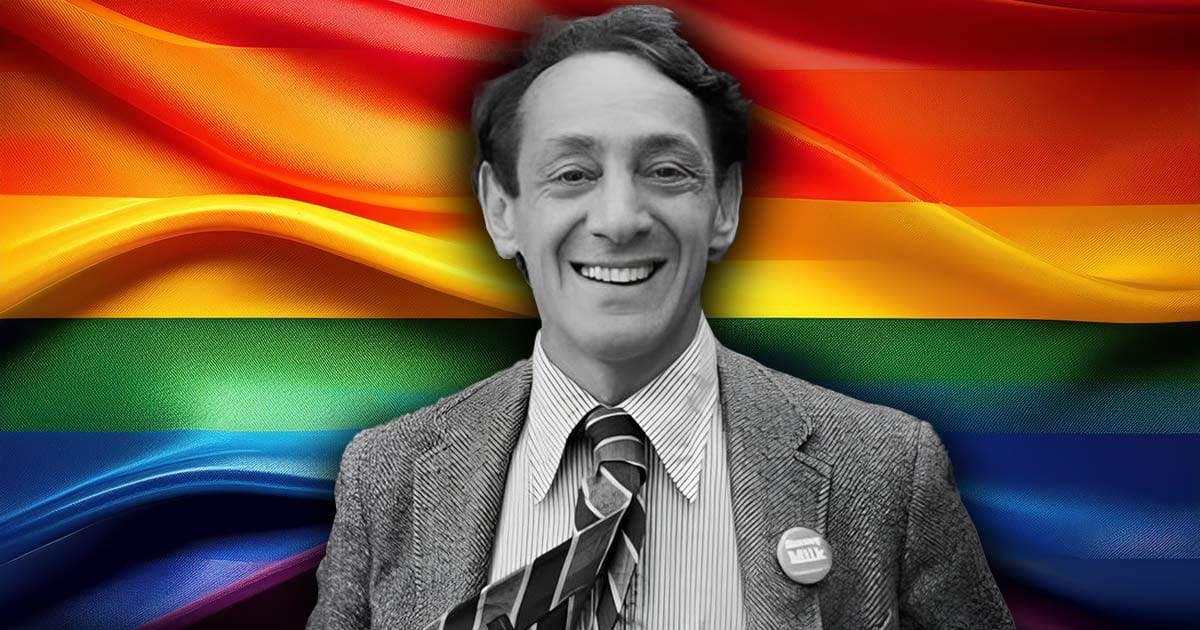
Harvey Milk was a groundbreaking American politician and gay rights activist during the 1970s. Time Magazine described him as “the first openly gay man elected to any substantial political office in the history of the planet.”
Milk became one of the first openly gay elected officials in the United States when he secured a seat on the San Francisco Board of Supervisors in 1977. He rose to prominence during a time of significant political transformation in San Francisco and increasing visibility of gay and lesbian people in American society.
Although his life was tragically cut short by assassination, Milk became a global symbol of defiance, pride, and hope for the LGBTQ+ community. He particularly advocated for queer people—especially public figures—to come out as a way to increase visibility and foster acceptance.
“I can only hope that… the gay doctors will come out, the gay lawyers, the gay judges, gay bankers, gay architects … I hope that every professional gay will say ‘enough’, come forward and tell everybody, wear a sign, let the world know. Maybe that will help,” he said.
Early Life and Career
Harvey Milk was born on 22 May 1930 in Woodmere, New York, to a middle-class Jewish family. He realised he was gay while still in high school. After graduating from college in 1951, he enlisted in the US Navy and was stationed in San Diego, where he served as a diving instructor. In 1955, the military discharged him under an “other than honourable” status after officially questioning his sexual orientation.
Over the years, Milk worked as a teacher, stock analyst, and in the production of several Broadway musicals. He became increasingly politically active, including protesting the Vietnam War.
Rise to Political Leadership
Milk moved to San Francisco in 1972 and opened a camera shop in the city’s Castro neighbourhood, then the centre of a growing queer community. He quickly emerged as a community leader and became known as “The Mayor of Castro Street.” In 1973, he ran unsuccessfully for the San Francisco Board of Supervisors. He ran again in 1975 and finally won election in 1977.
Milk took office as a City-County Supervisor on 9 January 1978, making national and international headlines. In office, he championed LGBTQ+ rights through an anti-discrimination ordinance and advocated for initiatives such as day-care centres for working mothers, improved library services, and community policing. He also fought for the rights of women and racial and ethnic minorities.
He vocally opposed a California ballot initiative that sought to ban gay and lesbian teachers from public schools. Voters ultimately rejected the proposal.
Milk frequently spoke at LGBTQ+ Pride events—then still in their infancy—calling for equality and visibility.
“We are coming out to fight the lies, the myths, the distortions. We are coming out to tell the truths about gays, for I am tired of the conspiracy of silence, so I’m going to talk about it. And I want you to talk about it. You must come out,” he urged.
Assassination and Aftermath
Milk received numerous death threats and anticipated the possibility of being killed as an openly gay public figure. In a recorded statement, he famously declared:
“If a bullet should enter my brain, let that bullet destroy every closet door.”
On 27 November 1978, former city Supervisor Dan White entered San Francisco City Hall with a gun. He shot and killed Mayor George Moscone in his office, then found and shot Milk five times. Milk was just 48 years old.
White was charged with murder, but his lawyer argued that he had “diminished capacity” at the time of the killings. The jury found White guilty only of voluntary manslaughter for both deaths. With time served, he received an effective five-year prison sentence. The verdict triggered the “White Night” riots, with around 3,000 people protesting at City Hall.
Legacy and Global Impact
In a 2019 interview with MambaOnline, former South African Constitutional Court Justice Edwin Cameron reflected on Milk’s influence:
“There’s no doubt that every single coming out contributes to a mind shift. That’s why Harvey Milk was so right – that coming out is an intrinsically, inextricably political act because you have a social impact when you come out,” Cameron said.
In 2008, Milk’s life was brought to the screen in an Oscar-winning film directed by Gus Van Sant. Sean Penn starred as Milk, with James Franco as his partner Scott Smith and Josh Brolin as Dan White. The film won the Academy Awards for Best Original Screenplay (Dustin Lance Black) and Best Actor (Sean Penn).
In 2009, US President Barack Obama posthumously awarded Milk the Presidential Medal of Freedom, the highest civilian honour in the country. That same year, California officially declared 22 May as Harvey Milk Day. In 2021, in recognition of the injustice he suffered in the military, the US Navy named a ship after him.
A Lasting Symbol of Courage
Harvey Milk’s legacy endures as a reminder of the power of visibility, advocacy, and courage. His call to “come out” remains a rallying cry for LGBTQ+ individuals seeking justice and dignity. As a pioneer who lived—and died—fighting for equality, Milk continues to inspire generations around the world to speak out, take space, and demand change.