
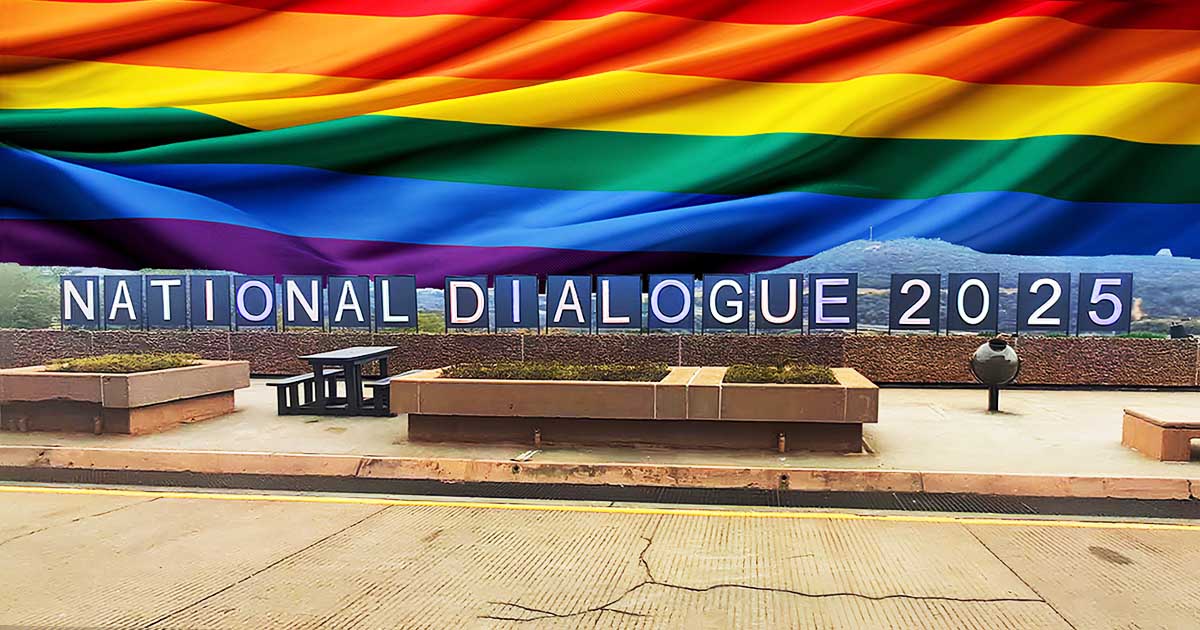
Following the first National Dialogue Convention held this past weekend, the LGBTQIA+ sector convened its first engagement meeting to discuss its role in the national reconciliation and reform process announced by President Cyril Ramaphosa.
The meeting, held on Monday evening, was described as an “icebreaker” aimed at aligning the sector around expectations, interim leadership, and next steps.
Three interim leaders – Tebogo Karabo Legodi, Lee-Anne Walker, and Marble Bore Kalembo, were nominated at Saturday’s National Dialogue session to represent the sector in the broader process. Their role is twofold: to mobilise LGBTQIA+ voices for participation and to liaise with the Planning Task Team (PTT), the Presidential team, and the Inter-Ministerial Committee (IMC).
The National Dialogue framework
The National Dialogue process, which will run until June 2026, aims to host an estimated 60,000 community dialogues across the country. Each of the 22 identified sectors, now expanded to nearly 40 after pushback at the Convention, is required to elect three representatives to sit on a steering committee. These representatives will not only carry the concerns of their own sector but also help drive the national process forward.
LGBTQIA+ participants raised concerns about whether queer issues might be sidelined in a larger process dominated by more established sectors like business and labour. Kaye Ally, Founder of Johannesburg Pride and the Pride of Africa Foundation cautioned against allowing “the usual prospects in the state” to dilute the LGBTQIA+ agenda, emphasising that the sector must insist on equal footing and proven achievements in areas such as health, justice, security, and education.
Responding to these concerns, Anzio Jacobs, a member of the Convention Organising Committee, explained that while steering committee representatives would not solely advocate for their own sectors, the LGBTQIA+ community could and should use the wider dialogue framework to ensure its issues are raised at community, provincial, and national levels.
“The LGBT sector will have every opportunity to dialogue not only itself, but to bring others into the dialogue,” Jacobs said. “Strategic deployment is key if we don’t want our voice to be drowned out.”
The meeting also touched on inclusion of foreign nationals and LGBTQIA+ asylum seekers in the process. While organisers affirmed that “no one should be excluded,” concerns were raised about safety, particularly given the participation of anti-migrant groups such as Operation Dudula in the Dialogue. Jacobs encouraged participation but acknowledged the risks.
Ultimately, Monday’s engagement concluded with consensus that the LGBTQIA+ sector must:
- Consolidate its interim leadership before 1 September;
- Develop a sectoral strategy to ensure visibility, inclusion, and human rights protection in the Dialogue process;
- Mobilise grassroots participation so that queer voices are present in local dialogues across the country.
“This is not about endorsing anyone’s agenda,” one interim leader noted. “It is about ensuring that our sector is represented in shaping South Africa’s future.”
Meet the interim leadership
- Lee-Anne Walker, from Pretoria, Gauteng, is Executive Director of Be True 2 Me, also a member of the Gender Diversity Coalition and serves as the C20 LGBTIQ+ Representative, and now takes on the role of interim leader for the LGBTQIA+ sector in the National Dialogue.
- Marble Bore Kalembo, based in Polokwane, Limpopo, is the Deputy Director in the Office of the Premier (Limpopo Provincial Government). Kalembo is also the ANC Women’s League Limpopo Provincial Spokesperson, a member of the ANCWL LGBTQIA+ Desk PEC, and serves on the Embrace Diversity NEC.
- Tebogo Karabo Legodi, from Gauteng, is the Deputy President of LGBTQIA South Africa, the Deputy Chair of the City of Tshwane Pride of Africa, a Joburg Pride volunteer, and a sector representative on the Department of Justice Desk for Non-Violence.
The interim leaders emphasised that their immediate task is to lay the groundwork for the sector’s involvement in the National Dialogue, coordinate engagement, and ensure LGBTQIA+ concerns are consistently represented.
“Our duty is to lay a solid foundation so that we can start with our work,” said Kalembo.
A critical moment for queer advocacy
Queer civil society groups have welcomed the step, describing it as a crucial moment to strengthen LGBTQIA+ advocacy within a national framework. Participation in the Dialogue is expected to amplify issues such as equality before the law, protection from hate crimes, and the need for inclusive governance.
The move comes amid ongoing challenges faced by queer South Africans, including rising violence against LGBTQIA+ people, limited access to affirming healthcare, and social exclusion. Leaders and activists hope that a united sector voice in the National Dialogue will help push these concerns higher on the national agenda.
While the Dialogue process has been met with some scepticism by parts of civil society, LGBTQIA+ representatives say engaging in it remains vital. “If we are not at the table, our issues risk being ignored,” one participant remarked during the Convention.
The LGBTQIA+ sector will continue to meet in the coming weeks to refine its strategy and prepare for participation in the steering committee once it is formalised.