

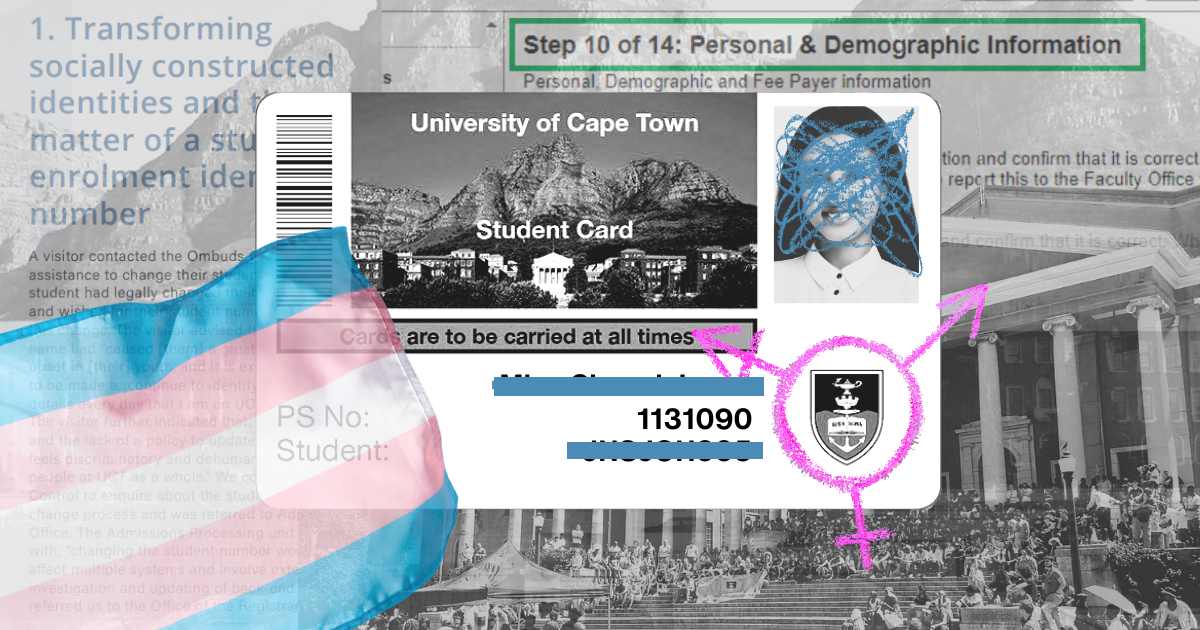
LGBTQIA+ student advocacy group RainbowUCT is leading a campaign urging the University of Cape Town (UCT) to implement trans-inclusive student identification policies. Current UCT student IDs deadname transgender students, leaving students vulnerable to harassment.
It’s a new academic year, and university students across the country are preparing for their studies in 2026. The annual university registration period, a time that should signal optimism and new beginnings for students, is marked by strife for many students at the University of Cape Town.
Barriers between receiving a tertiary education and the rights and dignity of students exist on many fronts, from the ongoing fees and accommodation crisis to gender-based violence in UCT’s residences. One such barrier is the full recognition of transgender students.
UCT’s current methods for recording a student’s personal information require transgender students who wish to change their name to navigate tedious administrative barriers. Even when a name change is successfully processed, its implementation is often inconsistent. The most glaring example of this inconsistency is UCT student numbers, which contain a portion of a student’s deadname – a trans person’s birth name that they no longer use.
There have been multiple attempts by trans students to change the misidentification on their student cards, with a student even approaching the UCT Ombuds Office in 2023 with the issue. Despite recommendations from the Ombud, UCT has yet to implement any changes to rectify this issue.
RainbowUCT, UCT’s student-led LGBTQIA+ advocacy organisation, is leading a campaign to draw attention to this issue and urge UCT’s administration to implement the recommendations from the 2023 Annual Ombuds Report. MambaOnline spoke to the student leaders of the campaign to understand the issue and the way forward.
UCT’s Campus ID System, Student Records and the Harm of Deadnaming
UCT’s student identification system is vast and integral to the day-to-day experience of UCT students. Every UCT student has two identifying codes, a student number and a PeopleSoft number.
UCT student numbers are created according to the name on a student’s government-issued ID at the time they first applied to UCT. It consists of the first three consonants of a student’s surname, followed by the first three letters of their forename, followed by three numbers that differentiate it from the student numbers of other enrolled students. For example, the student number of the first student to enrol under the name ‘Mary Smith’ would be ‘SMTMAR001’.
This student number is reflected on class registers, in UCT email addresses and appears very visibly on UCT student cards – an ID card that must be carried by students at all times, which is used to access buildings, UCT shuttles and residence dining halls, and must be visible to invigilators during exams.
This presents issues for trans students. Firstly, to apply for a change of forename with the UCT Student Records Office, a student must first have their name legally changed, a process that can take anywhere between a few months to a few years. (It is unlikely that young trans students will apply to UCT for the first time with an ID that reflects their correct name and gender marker.)
Yet, even if a student’s forename is updated by the university, the student number, including the original letters referring to the forename used at the time of registering, cannot be changed or reissued.
“It’s a very ominous feeling, looking at my student number,” Lilly Ahatefu, RainbowUCT’s Project Lead for Advocacy, told MambaOnline. “I’m sure with some creative googling you could find my previous name. I don’t like having my deadname so noticeable. I’m one of the only people I know who has a student number that isn’t based on my name, which obviously invites questions and feels like I am being outed,” she shared.
Ahatefu described an incident at her UCT residence where wardens were conducting a fire drill and were ticking off students on a register. The register only displayed Ahatefu’s student number, creating confusion and putting Ahatefu in an uncomfortable position, potentially outing her to the wardens.
She added that this mismatch creates potential for discrimination and can be a source of pain for trans students. “I would feel more comfortable if I wasn’t constantly reminded of my deadname. I have otherwise eradicated it from my life,” she emphasised.

The 2023 Annual Ombuds Report
RainbowUCT is not the only party to approach UCT about this issue. The 2023 Annual UCT Ombuds Report details a complaint brought to the office by a student who attempted to update their student number after legally changing their name and was told it was not possible.
The office approached several university structures and was eventually referred to the Office of the Registrar. They communicated that changing a student’s number was “highly impossible” because it is linked to student records, assessments and information needed for graduation and that changing a student’s number would “mess up” the student’s records.
The Ombud then investigated the policies laid out by the Certification for the Higher Education Sector on the matter and found that Section 6.4.6 of the policy stipulates that if a student is wanting to change the information in their records, “… an exception is allowed where the recipient has undergone legal change in one or more of her or his names prior to completing the studies leading to the qualification.”
The recommendation given to UCT by the Ombud’s report states, “It is paramount that the University designs an effective system where a student number can be changed if the person has changed their identity, name, etc., without compromising the integrity of its system. We know it can be done, and that it was not “highly impossible” as communicated.”
An alternative recommendation was scrapping student numbers and exclusively using PeopleSoft numbers, a unique 7-digit code linked to exam scripts and other student information.
Petitions, Public Support and Action Moving Forward
RainbowUCT began engaging with university staff about the logistics of changing student numbers in April 2025, but was largely met with silence or referrals to other university structures. On the 24th of October 2025, RainbowUCT launched a public petition urging the university to adopt the recommendations of the Ombuds Office.
The petition received over 700 signatures, including signatures from various civil society organisations, UCT staff members, and notably from influential queer philosopher Professor Judith Butler.
The petition was accompanied by an open letter from former RainbowUCT secretary general and campaign leader, Maeve Bayley, detailing her experience as a trans woman navigating these administrative issues.
Bayley emailed the open letter and petition to the Vice Chancellor and the Office of the Registrar in early November 2025, but received no response. On the 4th of December 2025, she delivered a copy of the open letter and petition signatures to the secretary of the Vice Chancellor and had the petition acknowledged by Deputy Vice Chancellor, Professor Elelwani Ramugondo. However, neither Bayley nor Ahatefu have received any subsequent communication from UCT staff about progress on the matter.
Frustrated by UCT’s continued lack of action, Bayley expressed, “We need change and we need it now, because registration is about to start and I don’t want to register for a postgraduate degree at UCT and still have my student card and email address displaying my old name. It’s ridiculous that UCT students are expected to deal with this because other institutions have dealt with this effectively”.
Bayley added that as a new academic year begins, this issue demands attention and urgency. “If UCT genuinely cares about transformation, this is something we need to change. We can’t claim to be the best university in Africa if we can’t get something as simple as this right,” she told MambaOnline.
MambaOnline has reached out to UCT for comment and will publish a follow-up article if a response is received.
Malaika Delport is a former student of the University of Cape Town and served as the chairperson of RainbowUCT between 1 October 2023 and 1 October 2025.