
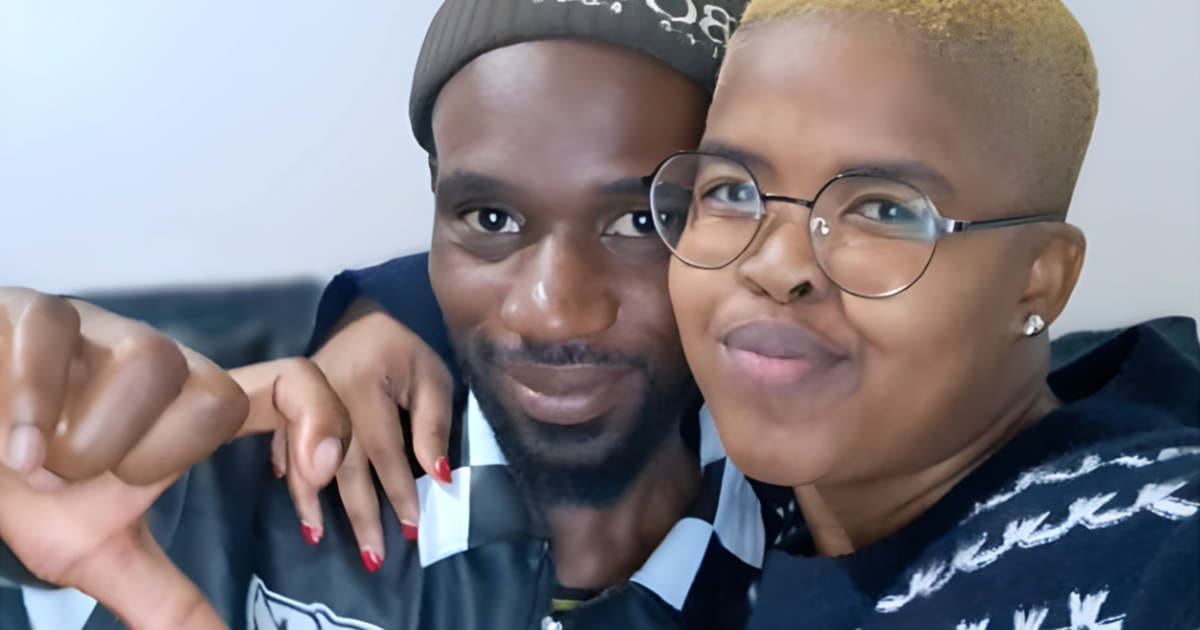
MambaOnline travelled to East Africa to meet Lukenge Kulaiba, a gay Ugandan man and LGBTQ+ activist, after he contacted our newsroom while he was fleeing Uganda and searching for safety. Following our initial contact, MambaOnline worked with partners and community members to help connect Lukenge with a safe house in the region. Managing Editor Nompilo Gwala recently travelled to meet him in person and document his story.
On 20 July 2026, MambaOnline received an urgent WhatsApp message from a young Ugandan man who said he was running for his life.
His name was Lukenge Kulaiba.
He was not contacting the newsroom simply to tell his story. He wanted his story to be documented because he feared he might be killed.
“I wanted someone that can share my story,” Lukenge told MambaOnline. “I know anytime I may be murdered. But what was my greatest fear is to be killed without any documentation.”
For a man who had already fled violence, crossed borders, moved between safe houses and lost contact with people close to him, telling his story had become a form of resistance.
“I know anytime I may be murdered. Even if I leave this world, [I hope that] anyone can document the struggle that I passed through,” he says.
Lukenge’s account, supported by documentation he provided to MambaOnline, describes a desperate journey from Uganda through Rwanda, Tanzania and Kenya, as he tried to escape people he believed were hunting him because of his LGBTQ+ identity and activism.
At the centre of his story is a media outlet with a notorious history of outing LGBTQ+ people.
‘I was almost beaten to death’
Lukenge says the persecution he faced as an LGBTQ+ person in Uganda intensified after the country’s Anti-Homosexuality Act was passed in 2023.
“After the passage of the Anti-Homosexuality Act in Uganda in 2023, I was attacked by a mob,” he recounts. “I was almost beaten to death.”
He says police took him to court on homosexuality charges, where a magistrate at Buganda Road Court ordered that he be treated for his injuries.
“I was given care, and later, in December, the charges were dropped.”
But the violence did not stop. Lukenge says he later moved to Busega, a neighbourhood within Kampala, where he was targeted again.
“I was even also attacked there in Busega. So, I ran for my life to Tanzania because I had a brother there.”
That escape would also fail.
Lukenge says his brother discovered that he was a member of the LGBTQ+ community and reported him to the police. Lukenge was subsequently returned to Uganda.
He eventually moved to Masaka, a major commercial city in Uganda, where he and others established a safe house on land he had inherited.
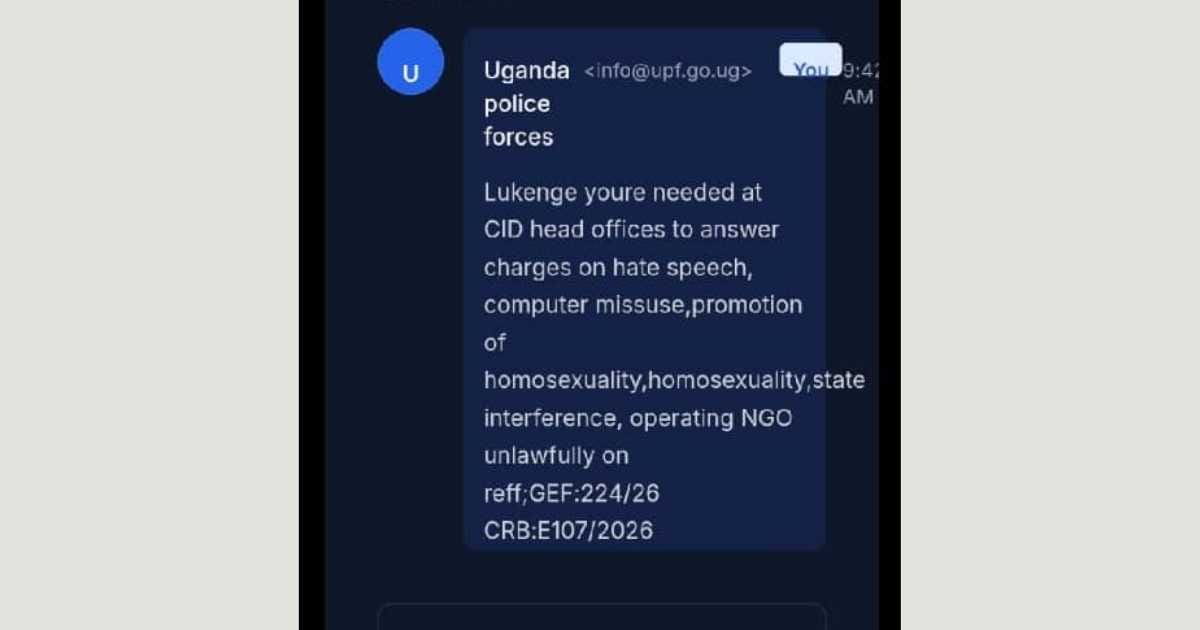
For a while, it gave him somewhere to live in relative safety. Then, on 24 June 2026, came an email.
‘Where did they get my email?’
Lukenge says that the email came from the Ugandan police. He did not respond.
“I wondered where they got my email,” he says.
It was a particularly alarming question because, according to Lukenge, the LGBTQ+ organisation he was involved with operated underground.
“In Uganda, LGBTQ organisations are banned. You cannot operate. So, you operate in hiding,” he explains.
He later discovered how his details may have reached the authorities.
The notorious publication Red Pepper, he says, had shared his personal information online.
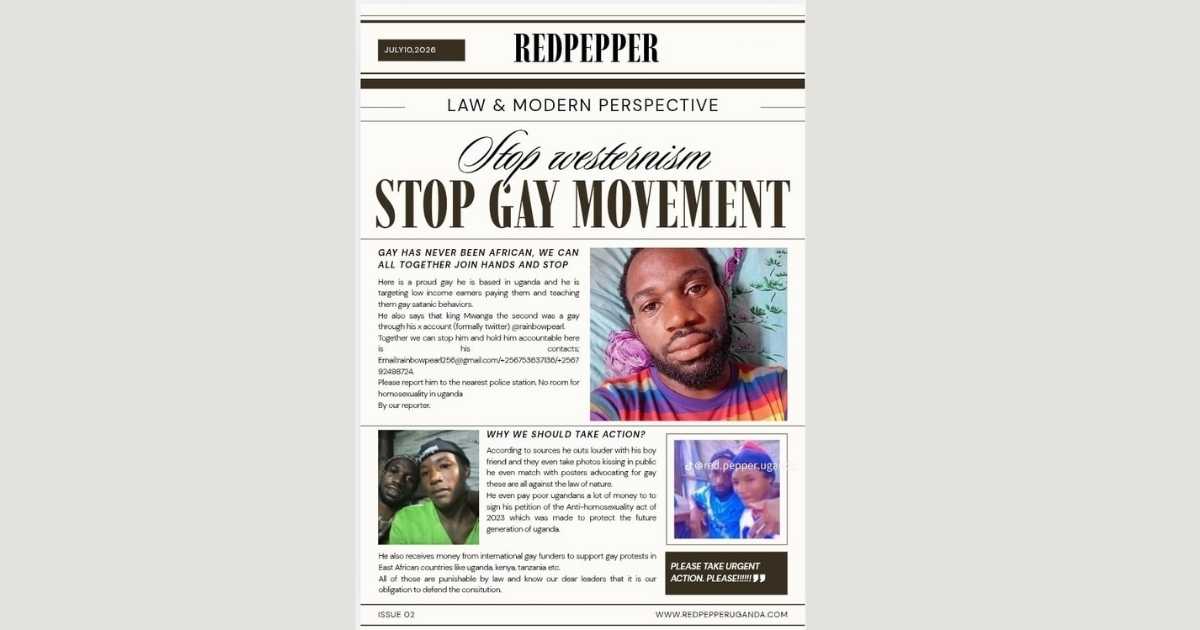
The newspaper has a long and documented history of outing people it identified as LGBTQ+. Infamously, in February 2014, Red Pepper published a front-page list naming “200 top homosexuals” under the headline “EXPOSED!”, just one day after President Yoweri Museveni signed Uganda’s first anti-homosexuality legislation (which was later nullified in court on a technicality).
More than a decade later, Lukenge found himself becoming a victim of the same publication’s dangerous outings.
Soon afterwards, he began receiving repeated calls from police officers.
“They were telling me, ‘You come and we are going to have a simple conversation,’” he says.
He did not go.
“I didn’t go because I know what might come. I will either be arrested or worse.”
For Lukenge, being publicly identified was not simply an invasion of privacy.
It made him a target.
A journey across borders
Lukenge and fellow activist Feizi were among those whose photographs appeared in the publication.
With their identities exposed, they decided to leave Uganda.
They travelled towards Rwanda, but deliberately avoided known border crossings because they feared Ugandan intelligence networks operated beyond the country’s borders.
He was aware of cases involving Ugandan activists who had reportedly been apprehended outside Uganda and returned to the country.
Rwanda, however, did not provide the safety they needed. Lukenge and Feizi eventually moved to Tanzania.
But, even there, the calls continued from people he believes were connected to Uganda’s security structures.
Then came the moment that changed his journey again.
‘Feizi was taken’
Lukenge and Feizi were in Arusha when they received information that people were looking for them.
They had been staying at a lodge.
At one point, Feizi returned to the lodge because he had forgotten his identification document.
He never came back.
According to Lukenge, the lodge’s landlord called him and said that people wearing plain clothes and carrying guns had taken Feizi.
He says the landlord had been held at gunpoint.
“Feizi was taken. Up to now, I have never… I don’t know whether I will ever get to hear from him,” says Lukenge, becoming emotional.
He had been running from one country to another, but now he was without the person who had been making the journey with him.
Lukenge was sure he could be next.
“I told Feizi, ‘let’s pack things and run away’,” he recalls saying to his friend before his disappearance.
Now he had to leave alone.
The messages stopped
With little money left, Lukenge found an elderly truck driver who agreed to take him towards Kenya.
During this journey, sitting in the truck, he remained in contact with MambaOnline, speaking to Managing Editor Nompilo Gwala via WhatsApp.
Then the communication stopped.
MambaOnline could no longer reach him.
Days passed. Messages remained undelivered.
“I remember trying to get hold of you and none of my messages were going through. I could not sleep that night, worried that something may have happened to you. I even left a few messages and it was just one tick,” Nompilo told him when they met face to face.
Lukenge had run out of data and power. He eventually sold another phone to raise money and continued moving.
He was trying to survive.
His journey took him towards Namanga, the border between Tanzania and Kenya. Lukenge says he deliberately avoided formal border procedures.
The truck continued towards Kenya.
But near Kitengela, the vehicle broke down.
Eventually, Lukenge left the truck and found a matatu, a minibus used as a shared public taxi, to continue his journey.
He took the back seat. Then another man got in. The man was dressed in plain clothes and initially spoke to Lukenge in Swahili.
“I don’t know any Swahili languages,” Lukenge recalls.
The man switched to English. He asked Lukenge who he was.
“I told him that I’m new here. I’m just moving around.”
Then he asked for Lukenge’s documents. Lukenge resisted.
“Little did I know that he was a police officer,” says Lukenge.
The man reported him to police, who discovered that his passport did not have an entry stamp.
He was taken to a police post and eventually referred to Nairobi Central Police.
There, Lukenge says, officers told him he could not remain in Kenya. He was subsequently driven towards Busia, the border between Kenya and Uganda, with a police officer assigned to escort him.
The possibility of being returned to Uganda was terrifying. However, he managed to escape once again.
And once again, his phone went silent.
‘If the police get me, I’m finished’
Lukenge says that after reaching Busia, he used another phone and eventually managed to reconnect with people who were trying to help him.
He was preparing to travel towards Ethiopia when he received a call from a contact person referred by MambaOnline, who urged him to stop. That call eventually led him to a queer individual, Kuku, whom he met in the town of Kakuma.
“He’s a good queer friend of mine,” Lukenge says. “He showed me hospitality, good care. He showed me love exactly.”
He was brought back to safety.
Eventually, he was able to contact MambaOnline again.
The disappearance of Lukenge from WhatsApp had not been a communications glitch. It had been another chapter in a journey where staying connected could itself become dangerous.
‘Why I contacted MambaOnline’
When asked why he chose to reach out to MambaOnline, Lukenge’s answer is simple.
“I found MambaOnline on my search for safety,” he says.
He had first tried contacting another organisation by email but had not received a response quickly enough.
Then he found MambaOnline’s WhatsApp number.
“On WhatsApp, even if you just load data, you open there,” he explains. “You can get a notification that someone has contacted you.”
The newsroom connected him with Mandy Jovial, a Ugandan activist living in South Africa who works with MambaOnline.
“Mandy knows what’s going on in Uganda,” Lukenge says. “Mandy was open to me. I felt at home.”
For Lukenge, MambaOnline became more than a platform to tell his story. It became part of the chain of people helping him survive.
“All the way from South Africa, they had connected me to this house [of safety] here,” he says.
“You see? That setup is like a chain. A chain. That’s what I can say.”
‘I don’t fear death’
Throughout the interview, one message kept recurring. Lukenge does not know what will happen to him. But he wants people to know what happens if he does not survive.
Yet he does not want his story to be remembered only as a story of fear. His message to queer people in Uganda, and to LGBTQ+ communities elsewhere facing repression, is one of defiance.
“First of all, our freedoms are not a subject of negotiation,” he says. “We need not to let governments negotiate on our existence.”
He believes people should not allow fear to silence them.
“I don’t fear death. For sure, because I know I will not live for 200 years. Anytime I’m going to die.”
His conclusion is uncompromising.
“So, let them stand up for their rights, because freedom does not come to those who cry. Freedom comes to those who stand and fight for their rights. I have a belief we are going to win.”
For Lukenge, this is no longer an abstract debate about LGBTQ+ rights.
It is about survival. It is about what happens when a person is outed, attacked, hunted and forced across borders because of who they are.
It is about safe houses becoming unsafe. It is about a phone going silent and people wondering whether the person on the other end is still alive.
And it is about a young man who, while travelling in the back of a truck towards an uncertain future, reached out to a queer newsroom in another country and said, in essence: if I don’t survive, please make sure my story does.
Editor’s note: MambaOnline has withheld Lukenge’s current location and other identifying information that could place him or people assisting him at further risk. MambaOnline has reviewed and received documentary material from Lukenge relating to the claims detailed in this article, including screenshots, communications and other records. Allegations concerning Ugandan authorities, the detention of LGBTQ+ activists and the disappearance of Feizi are presented as allegations based on Lukenge’s testimony and the documentation he provided. MambaOnline has taken care to distinguish his account from independently established facts. Some identifying details have also been omitted for safety reasons.