

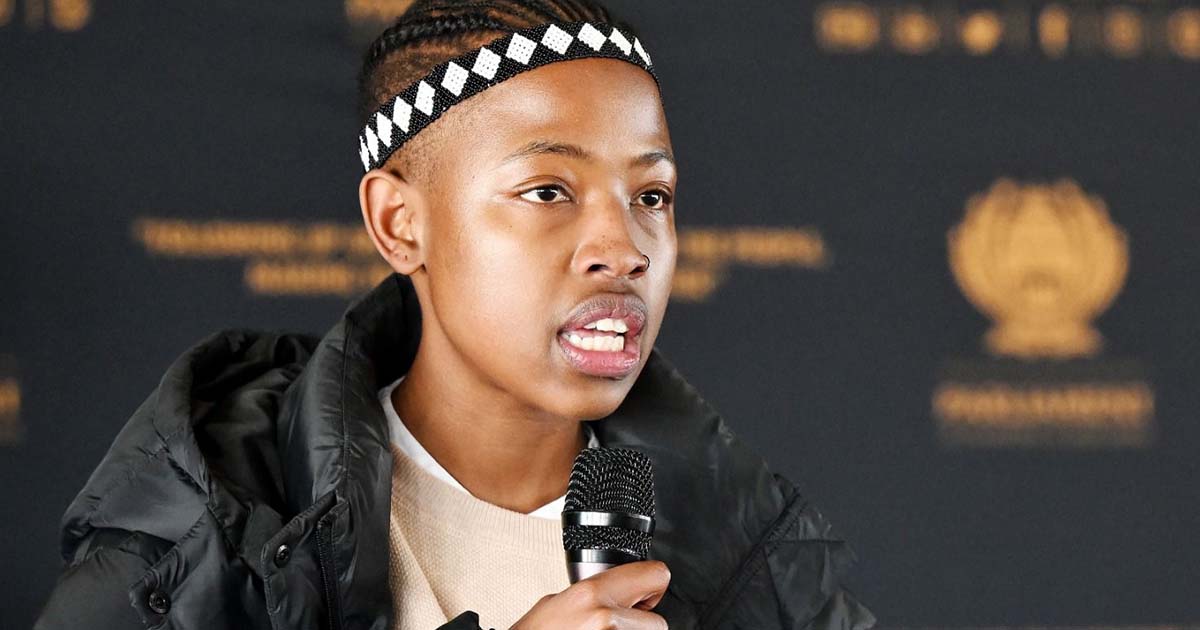
As Parliament travels the country to hear public input on South Africa’s new Marriage Bill, queer MP Palomino Jama found themselves not only bearing witness to public engagement, but to public hostility and derision. In this searing personal account, Jama reflects on the hate they encountered during the public hearings, and why equality and dignity can never be undermined under the guise of culture, religion, or tradition.
On Saturday, 26 July, as a queer Member of Parliament, I sat through public hearings on the Marriage Bill at the Toronto Recreation Centre in Welkom.
This bill seeks to bring South Africa’s fragmented marriage laws under one inclusive, constitutional framework.
Among other things, the Bill affirms the right of all people, regardless of sexual orientation or gender identity, to marry under equal conditions.
And yet, in these hearings, my very existence was not only debated. It was demeaned.
I expect disagreement. I respect religious and cultural views, even when they oppose same-sex marriage.
But what I heard was not disagreement. It was hate.
It was being called “it.”
It was hearing that queer love is “unnatural.”
It was an attack on how we raise children.
It was ridicule dressed up as opinion.
And throughout it all, parliamentary translators refused to learn the acronym, referring to our community as “that thing” in various languages.
Let us be clear.
Queer rights are not a special category. They are constitutional rights.
Same-sex marriage is already legal in South Africa. This Bill simply ensures equality across all marriage laws.
Public participation cannot be a licence for hate speech.
Parliament must never become a stage for bigotry masquerading as belief.
That is why I appreciated the Chairperson, Hon. Mosa Chabane, who stood up to affirm that such dehumanising language borders on hate speech and will not be tolerated in our democratic processes. It was a necessary reminder that dignity must never be up for debate.
What struck me most, and what cannot go unspoken, is the deep irony that much of the homophobia was expressed by Black South Africans, some of them women. It is a bitter paradox. Those who were once excluded from full citizenship on the basis of race and gender now echo the language once used to dehumanise them, and direct it at queer people.
It was not so long ago that Black people were denied the right to marry freely in this country. Customary marriages were not legally recognised. Interracial marriages were criminalised. Black women were considered perpetual legal minors, unable to sign contracts, buy property, or make independent decisions. The very institution of marriage was structured to exclude and control.
And let us not forget, the version of marriage so many are now rushing to “protect” was itself imported by colonial powers, used to undermine indigenous systems and impose control. To claim it as a sacred and original African tradition is to forget its imperial roots.
Religion was not neutral in this project. The apartheid regime relied heavily on religious doctrine, particularly from the Dutch Reformed Church, to justify segregation and racial supremacy. Passages from scripture were used to argue that white domination was divinely ordained. The Bible was used to sanctify violence and deny Black people dignity.
Today, that same theological logic is being repurposed, not to exclude on the basis of race, but on the basis of sexual orientation and gender identity. Once again, it is being done in the name of “tradition” and “God.”
We must refuse this cycle of oppression.
South Africa became the first country on the continent to legalise same-sex marriage, not because the majority supported it, but because our Constitution demanded it. Dignity, equality, and freedom are not up for debate. They never should be.
I stayed in that room, despite the discomfort and despite the violence, because I know I stand on the shoulders of giants. I thought of Simon Nkoli, who risked everything as a Black, openly gay anti-apartheid activist. He fought not only for freedom from racial oppression, but also for queer liberation.
I thought of the comrades who fought to have sexual orientation included in our Constitution, making South Africa the first country in the world to enshrine LGBTQIA+ equality in its founding document. I thought of those who challenged unjust laws, who organised in townships, and who built movements when it was neither safe nor popular to do so.
Their work made it possible for someone like me to sit in that room as an openly queer Member of Parliament.
I stayed, not for myself, but because we all have a responsibility to honour that legacy. We must defend the gains that were made and continue the fight for full dignity, safety, and belonging for all queer people in South Africa.
This moment demands clarity. The Marriage Bill (B43 of 2023) is intended to harmonise South Africa’s fragmented marriage laws into a single, inclusive framework. However, that inclusivity is not guaranteed. If queer people, activists, and our allies do not show up, we risk being legislated against in our absence.
Bigots are showing up.
They are coordinated, resourced, and loud. We must be, too.
I call on LGBTQIA+ organisations to organise, participate, and mobilise, just as we did from 2003 to 2006, when our communities came together to fight for the legal recognition of same-sex marriage and helped secure the passage of the Civil Union Act. That same spirit of unity, visibility, and determination is needed now. I also urge our allies, especially those of faith and of conscience, to stand with us.
Silence is complicity. Let us meet this moment with the courage and collective power it demands.
This debate has revealed more than disagreement. It has exposed just how fragile public understanding of the Constitution still is. The hate expressed in these hearings does not only target queer people. It undermines the very values our democracy is built on.
What we need now is not just tolerance. We need consistent and courageous leadership. Leadership that educates, protects, and insists that the rights in our Constitution belong to all of us, or they belong to none of us.
Together in Struggle
Hon. Sisipho “Palo” Jama
UPCOMING MARRIAGE BILL HEARINGS IN THE NORTHERN CAPE
4 August 2025
Municipality: Sol Plaatje Municipality (Kimberley)
District Municipality: Frances Baard District Municipality
Time: 10:00 – 15:00
5 August 2025
Municipality: Ga-Segonyana Municipality (Kuruman)
District Municipality: Ga-Segonyana Municipality (Kuruman)
Time: 10:00 – 15:00
7 August 2025
Municipality: Dawid Kruiper Municipality (Upington)
District Municipality: ZF Mgcawu District Municipality
Time: 10:00 – 15:00




3 Comments
First of all, brilliant article. I share every sentiment expressed in the article. It’s clear that we still have a long way to go as a country. It was truly shocking to witness that type of hate directed towards the LGBQTIA+ and it needs to be condemned. The only solution is to find a common ground and that common ground begins and ends with respect. I hope more efforts are done to educate the black community about LGBQTIA+ matters as a means to address the hate.
Currently the culture of marriage embodied by home affairs remains patriarchal, misogynistic and harmful for women (straight or lgbtqia). Women in straight marriage are second class citizens in home affairs procedures, discriminated against if divorced and excluded from systems. It makes one feel hopeless that our lgbtqia community will be treated equally under the law and in state institutions when half our population now, are not. Thank you for being there shouldering the heaviness of liberation. May your success find you quickly.
It can’t be that in South Africa even those are fundamentally against same sex relationships and marriages have still not learnt the meaning of equal rights for ALL. We still have a long way to protect our peers and children from hate. There is one thing for sure though…koshiyana ooMama ukondla!! We will not, we can never tire until we all have a shared experience of what Mzantsi can be.