


Cape Town Mayor Geordin Hill-Lewis has expressed his support for the Cape Town Pride Parade and Mardi Gras, which take place on Saturday, 28 February.
The events mark the culmination of a three-week Pride Festival that began on 6 February and featured film screenings, celebrations, book readings, comedy shows and a host of other queer events.
Organisers have confirmed that the City of Cape Town is once again the official sponsor this year, without which, they say, the Cape Town Pride Festival would not be possible.
“It gives me great pleasure, on behalf of the City of Cape Town and all our residents, to extend a warm welcome to everyone taking part in the 2026 Cape Town Pride Festival,” said Mayor Geordin Hill-Lewis in a statement.
“Each year, Pride transforms our city into a vibrant celebration of love, equality, and diversity – values that lie at the very heart of who we are as Capetonians.”
He added: “Cape Town is proud to be the most diverse and inclusive city in South Africa. We remain deeply committed to being a place where everyone – regardless of who they are or whom they love – feels safe, respected, and celebrated.”
#IAmBecauseWeAre: Honouring Ubuntu
This year’s theme, #IAmBecauseWeAre, draws on the spirit of Ubuntu.
“We stand rooted in Ubuntu — the truth that our lives are intertwined and our freedom woven together. This year, we honour 30 years of our Constitution and 20 years of marriage equality, reminders of a journey shaped by courage, struggle, and triumph,” said Cape Town Pride Brand Ambassador, Nkosinathi Sangweni.
“Even as our community continues to face real challenges, our voices rise, our stories grow louder, and our presence becomes ever more undeniable. Pride remains our declaration that we will not dim our light, that we will continue to love fiercely, and that we will shape a future where every one of us can stand fully seen.”
Parade Details and Mardi Gras Festivities
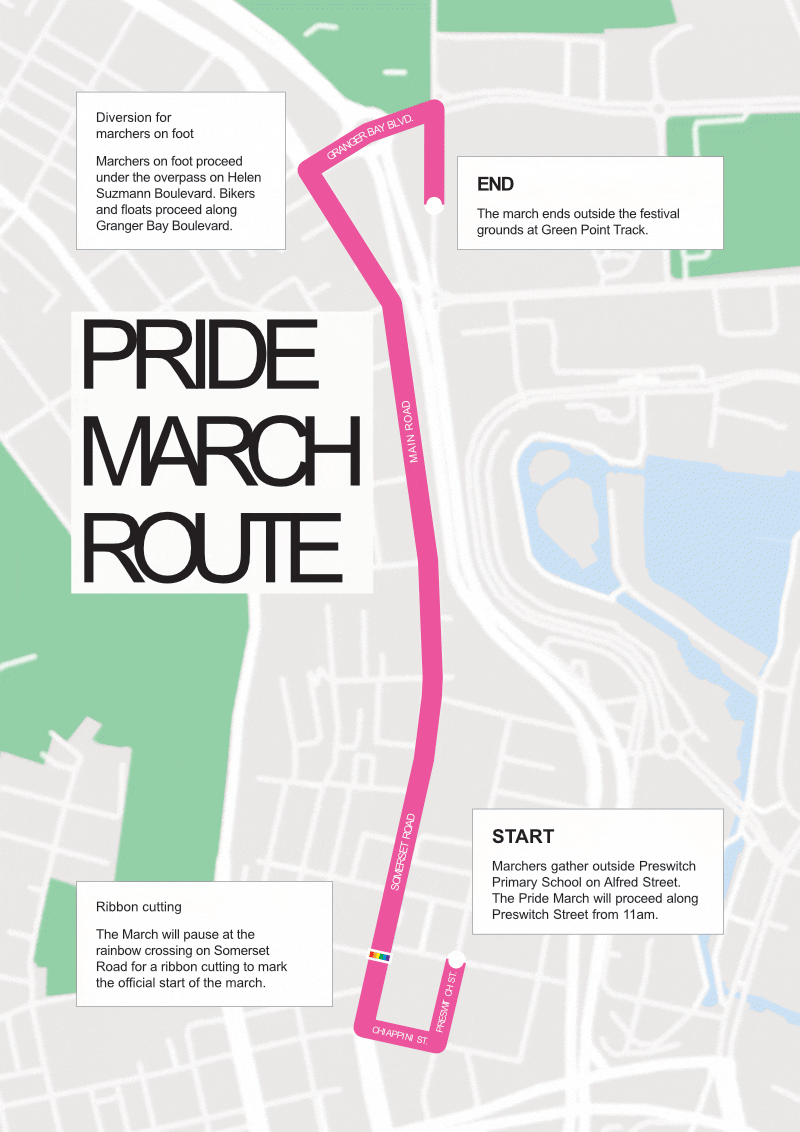
The Pride Parade takes place on Saturday, 28 February, starting as usual in Alfred Street in the De Waterkant district of Green Point at 11:00am.
The parade offers members of the LGBTQI+ community an opportunity to march in celebration of Pride. Participation in the parade is free.
The procession culminates at the Green Point Track, where celebrations continue at the Pride Mardi Gras. A limited number of tickets are available for sale.
The Mardi Gras will feature a dynamic line-up of live entertainment on the Pride stage. This includes Craig Lucas, Dope Saint Jude, Jimmy Nevis, Armand Joubert, Belinda Davids, DJ Lelowhatsgood, DJ K Dollahz, DJ Kixi, Tollie Parton in her role as DJ, the cast of Beaulah: Queens van de Kaap, Stella Rosé, and 3 Tons of Fun, who return by popular demand.
Attendees can choose from a wide range of food trucks, including vegan and halaal options. The Pride Market will offer a variety of goods, from rainbow-themed items and jewellery to artworks and temporary tattoos.
The NGO Village will also provide a space for organisations working within the LGBTQI+ sector to promote their services and engage with the community.
Free Passage on Golden Arrow Buses on Pride Day
If you live near a Golden Arrow bus route, you can travel to the CBD, and home again, for free on Saturday, 28 February, if you have a ticket to the Cape Town Pride Mardi Gras.
Simply show your ticket to the driver and get a free ride, anytime from 8.30 to 20.00 on existing bus routes (these are not special Pride buses).
Please note that there is limited service on a Saturday especially after 17h30. There will be no extra services scheduled after 20h00. You can call the toll free Golden Arrow Helpline for timetable enquiries on 021 466 7000.
Tickets for the Pride Mardi Gras are available on Quicket here.





2 Comments
Are We Prioritising Publicity Over People in the Mother City?
The City of Cape Town has once again thrown its weight behind a major public celebration, granting
support for Cape Town Pride on 28 February 2026, along with backing for a significant international
event scheduled for 2028. We are told these events promote unity, diversity and equality among us
as Capetonians.
But I must ask: unity for whom?
Equality in what measure?
And diversity at what cost?
No city can claim to champion equality while failing to address the daily suffering of its most
vulnerable residents.
We are informed that the City is facilitating aspects of these events, including logistical support and
public transport considerations. Yet many of our pensioners struggle to afford transport to clinics.
Schoolchildren in under-resourced communities travel long distances without adequate safety
measures. Where are their free rides?
If we speak of diversity and inclusion, then surely that inclusion must begin with pensioners who
survive on minimal grants, children in overcrowded classrooms, communities battling crime daily,
and families facing hunger and homelessness.
The Grand Parade has historically been a space meant to unite communities across faiths,
cultures, and backgrounds. Yet local groups often report having to fight for permits, safety support,
and municipal cooperation. Why must grassroots community initiatives struggle while large,
high-profile events receive swift approval and backing?
The City has the authority to grant major event status. It has the power to mobilise law enforcement
and traffic management for international spectacles. It can create global publicity campaigns.
But can it guarantee safer streets in crime-ridden areas?
An education system grounded in
academic excellence and factual integrity?
Adequate shelter for the homeless?
Food security for
the hungry?
Unity is not created through banners and parades alone. It is built when every citizen feels
protected, valued, and heard.
Equality is not selective visibility. It is consistent service delivery.
Diversity is not an event — it is a daily commitment to all communities.
Taxpayers are not wrong to question how their money is being spent.
When major events receive
municipal backing while basic service delivery remains inconsistent, frustration is inevitable.
It is not
intolerance to demand accountability. It is civic responsibility.
Cape Town is called the Mother City. A mother does not favour spectacle over sustenance. She
ensures that her children are safe, educated, fed, and housed before she hosts celebrations.
If we are serious about unity and diversity, then let us demonstrate it in how we allocate resources:
free transport for pensioners and learners, greater protection for vulnerable neighbourhoods,
transparent budgeting for public events, stronger investment in homelessness interventions, and
community-driven initiatives that bring all Capetonians together.
Public events have their place. Celebration has its value. But governance must prioritise necessity
over publicity.
The real test of equality is not whom we celebrate — it is whom we protect and provide for.
Until we align our spending with the urgent needs of our communities, many residents will continue
to ask: are we building unity, or are we building headlines?
Rev. O.P. Bougardt
This isn’t really about “people over publicity.” It’s about who you think deserves visibility.
You’ve made that clear in your Facebook post in which you praise Hungary’s efforts to “shield students from LGBTQI+ ideologies and propaganda.” So when you single out Pride here, it doesn’t read as a neutral concern about spending—it reads as a selective objection to one community. (Your post reads as follows: “Hungary deserves recognition for its decisive action in shielding students from LGBTQI+ ideologies and propaganda in schools, allowing them to focus on their academic pursuits. Well done.” I have a screenshot of it.)
If the issue were genuinely service delivery, you’d be pointing to budgets, allocations, and measurable trade-offs. You haven’t. Instead, you’ve implied that supporting Pride comes at the expense of pensioners, schools, and the poor—without offering any evidence that such a trade-off exists.
Cape Town’s inequalities are real and serious. Using them as a backdrop to question the legitimacy of one group’s visibility doesn’t address those problems. It simply reveals where you stand.
What you have really shown is bigotry, not civic concern.