

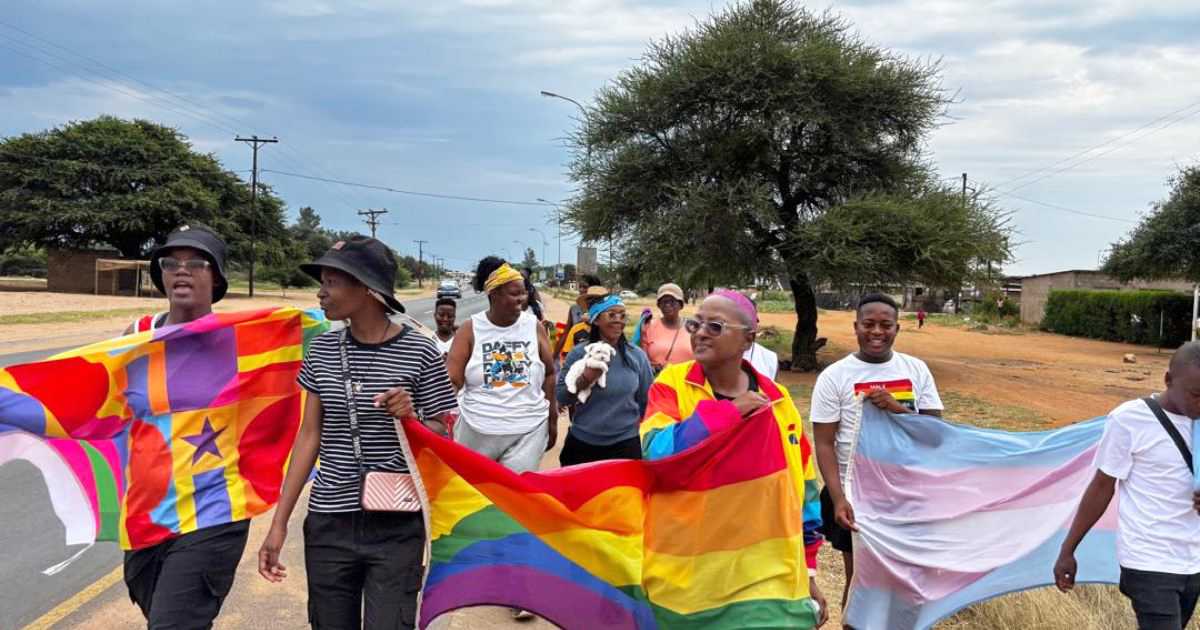
On 7 November 2026, the streets of Palapye in Botswana once again witnessed a declaration of queer existence, visibility and belonging.
A year after the town hosted its first-ever Pride march, AGANG Community Network returned with another gathering, determined to keep the spirit of Pride alive.
But this year’s march unfolded under different circumstances.
In an unexpected last-minute development, the police changed their position on providing an escort and asked participants to proceed with the march on their own. The reasons behind the change remain unclear.
For those preparing to take to the streets, this presented a difficult reality: marching without the reassurance of police protection meant confronting concerns about their safety on the roads.
There was fear. There was uncertainty. And there were fewer people than had attended the inaugural march in 2025.
Yet those who came did not turn back. They marched.
In a community where queer visibility can still invite scrutiny, discomfort and opposition, simply taking to the streets remains an act of determination.
Beyond the Numbers: The Courage to Keep Showing Up
The lower turnout compared to the previous year raises important questions about the sustainability of grassroots LGBTQI+ organising in smaller communities. While the inaugural Pride attracted considerable attention and brought together queer people, parents, religious leaders and allies, maintaining that momentum is not always easy.
Participation in Pride is shaped by many factors, including visibility, fear, social pressures and the realities of living in close-knit communities where personal identities and family relationships are often deeply interconnected.
A smaller crowd does not necessarily mean that the need for Pride has diminished. Nor does it erase the significance of those who continue to show up.
In many ways, the 2026 march demonstrated that movements are not sustained by numbers alone. They are also sustained by the determination of individuals and organisations willing to continue creating spaces for recognition, solidarity and belonging, even when conditions are difficult.
For AGANG Community Network, returning to organise Pride was itself an affirmation that the work initiated in 2025 was not intended to end with a single march.
Queer Joy Belongs in Everyday Spaces
Beyond the march, AGANG Community Network hosted an after-party at a local pub, offering another expression of Pride and community visibility.
Unlike an exclusively organised LGBTQI+ gathering, the pub remained open to its regular Saturday patrons. People came and socialised as they ordinarily would, including individuals who may not have been familiar with Pride or fully understood what the occasion represented.
This created an interesting intersection between a deliberately organised celebration of queer identity and the everyday social life of Palapye.
Sometimes, visibility happens through occupying ordinary public spaces, sharing experiences and existing alongside others without having to justify one’s presence.
The after-party offered an opportunity for queer joy to exist within the wider community, rather than apart from it.
It also reflected an important aspect of inclusion: creating opportunities for people to encounter one another beyond assumptions, labels and social divisions.
The Work Continues
The story of Palapye Pride is ultimately about more than two marches.
When AGANG Community Network organised the inaugural event in November 2025, it challenged the silence surrounding queer visibility in a semi-urban community where cultural norms, religious beliefs and traditions remain influential in everyday life.
A year later, the organisation returned, despite the challenges and uncertainties surrounding the second march.
“The circumstances may have changed, attendance may have been lower, and the reassurance of a police escort was absent. But the decision to continue was significant,” commented Seipone Boitshwarelo, founder of AGANG Community Network.
The first Palapye Pride was about opening a door. The second was about refusing to let that door close.
And perhaps that is the most important message from Palapye: courage does not always arrive with a crowd. Sometimes, it looks like a handful of people choosing to march, even when they are afraid.
The rainbow was still there. And so were they.