Opinion: From Awareness to Accountability – The Most Powerful 16 Days of Activism to Date
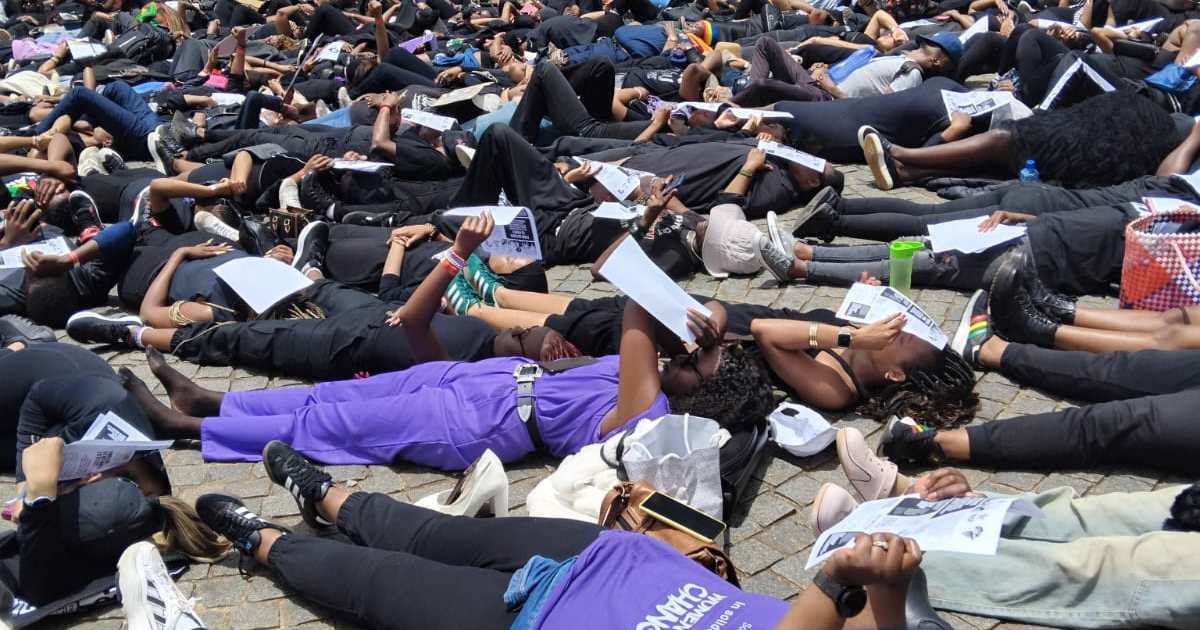
Protesters observe 15 minutes of silence at Constitutional Hill during the women’s nationwide shutdown ahead of 16 Days of Activism. (Photo: Thabsie Mabezane)
This year’s 16 Days of Activism for no violence against women and children felt heavier, clearer, and more insistent.
On the 21st of November, as the country responded to the National Gender-Based Violence and Femicide (GBVF) Shutdown called by Women for Change, women, members of the LGBTQIA+ community, and allies lowered themselves to the ground for 15 minutes. This symbolised the estimated 15 women killed every day in South Africa, a haunting, physical reminder of a crisis that continues to shape our homes and communities.
Honouring Survivors and the Lives Stolen
In an intimate gathering with the young traditional dancers, Amagidangoma Okhethelo and residents of The Fruit Basket, we honoured those who survived and those who never made it home. We spoke their names, sang for them, cried for them, and stood in the truth of what violence has stolen from our families. The scars on my mother’s back, the terror she survived as she was dragged from under the bed and pulled from inside a wardrobe were a painful but necessary memory to relive. No dignity, no justice. But my father walked away with impunity and continued to perpetuate that violence against me. This is the reality of our country: men harm with ease, while women and children carry the evidence on their bodies.
But something shifted this year.
Remembering the 16 Honoured Cases
The Forum for the Empowerment of Women, Sisonke, and The South African Network of People Who Use Drugs (SANPUD) stepped in with a bold, intersectional campaign that centred sex workers, queer persons, people who use drugs, and those who live under layered vulnerability due to disability or nationality. Their message was clear: GBV is not a single issue. It is shaped by patriarchy, poverty, criminalisation, homophobia, racism, and exclusion. Any campaign that ignores these intersections cannot hope to succeed.
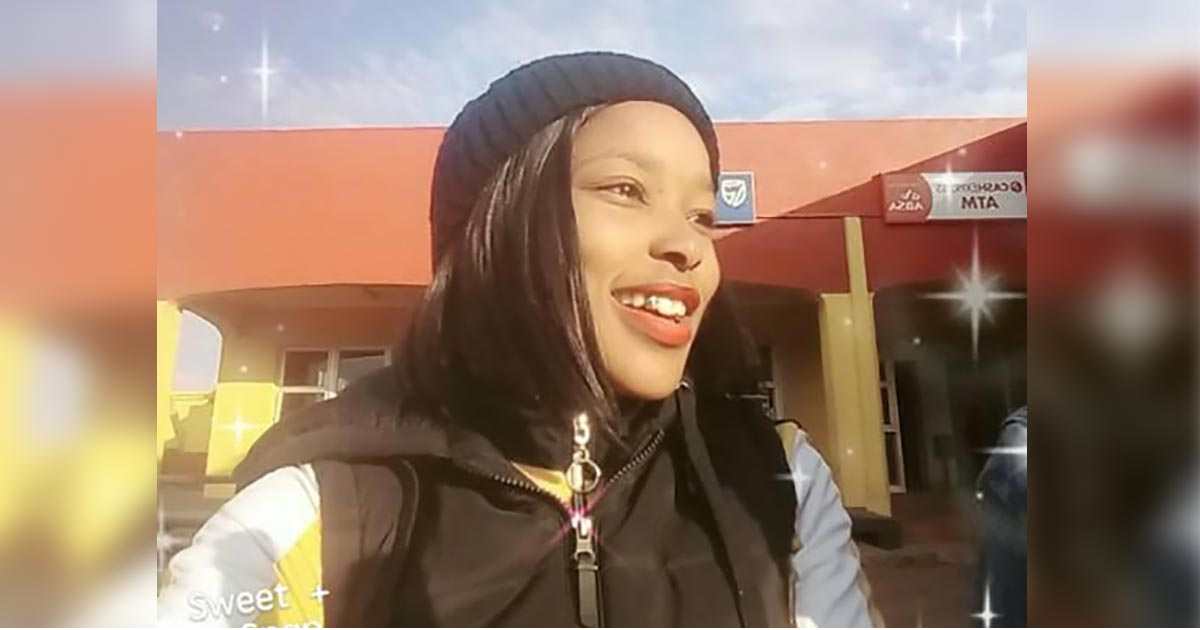
Bonang Gaelae was stabbed in the neck in February 2019.
During their commemoration they honoured 16 cases, each one a name, a life, a community shattered. Among them was Bonang Precious Gaelae, a 29-year-old lesbian woman murdered in Sebokeng in 2021. Her killer received 25 years not because the system works but because her community refused to be silent.
They also remembered the six women murdered by Sifiso Mkhwanazi in 2022 — many of them sex workers navigating stigma, criminalisation, and danger. Their case revealed how violence thrives where society turns its eyes away. Even Mkhwanazi’s father testified against him, a testament that accountability begins with confronting those we love.
On a global scale, the UN’s theme placed a spotlight on digital violence, a rapidly expanding frontier of harm. Violence no longer hides only in physical spaces, includes:
- Revenge porn and non-consensual image sharing.
- Cyberstalking and online harassment.
- The rise of the incel movement, which glorifies misogyny, violence, and the dehumanisation of women.
- Catfishing and digital luring, where perpetrators use apps to target marginalised people.
- Coordinated trolling and doxxing, used to silence women and queer activists.
The Alarming Rise of Digital Violence
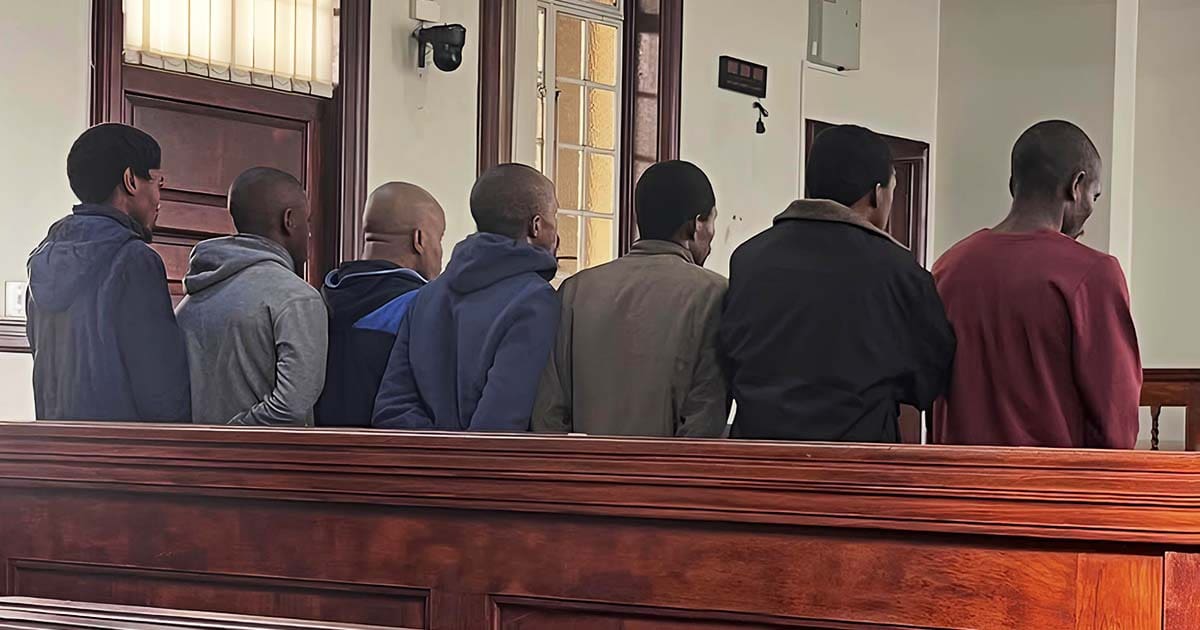
The seven Grindr Gang accused face charges related to the kidnapping, attempted murder and extortion of a Johannesburg student (Photo: Nompilo Gwala)
In South Africa, the dangers of digital violence became painfully clear in the case of the “Grindr 7” — seven men arrested in Johannesburg in 2023 for kidnapping and assaulting an 18-year-old university student. They allegedly used Grindr to lure him and then extorted his family with ransom demands. This case exposed how queer people, already unsafe in physical spaces, face new threats in digital ones.
Technology is not neutral, it mirrors society and it can quickly become a weapon. If we want to build a safer world, we must listen to history. In the early 2000s, when South Africa was buckling under the weight of the HIV epidemic, it was communities, not institutions, who held the country together. Neighbours cared for the sick, activists fought for treatment access, young people taught one another about prevention. The success of South Africa’s HIV response only became possible when government finally partnered with those already doing the work. The same truth applies now.
A Historic Demand: GBVF as a National Disaster
The National Strategic Plan (NSP) on GBVF is a promising example of what multi stakeholder collaboration can achieve — a framework built with activists, policymakers, researchers, and communities. But its impact depends entirely on implementation, resourcing, and political will.
Even with these advances in advocacy, the most powerful shift this year came from the people themselves. More than 1,126,137 South Africans signed a petition calling for GBVF to be declared a national disaster. It is a staggering show of public will, a collective refusal to accept that this is simply our reality.
Legally, this shift is profound.
Under Sections 23 and 26 of the Disaster Management Act, once GBVF is classified as a national disaster, the National Executive assumes responsibility for coordinating and managing the response across sectors. All organs of state are now obliged to:
- strengthen their support to existing GBVF structures,
- fully implement contingency arrangements, and
- activate every necessary mechanism for a coherent, national response.
This classification is not symbolic, it carries the weight of law. But the question that haunts us is whether it will carry the weight of action.
What South Africa Must Commit to Next
For people affected by violence every day, the 16 Days are not merely a season of awareness. They are a pause, a moment to hear what government and institutions claim they’ve done, and to measure those claims against lived reality. Awareness without accountability is a broken promise.
As we move beyond December 10th, the work ahead demands courage and clarity. To sustain momentum, South Africa must commit to the following:
- Men at the forefront: GBV is created by men. It must be dismantled by men. This is not a spectator sport — it is an urgent responsibility.
- Comprehensive sexuality education: Empowering young people with knowledge on consent, boundaries, relationships, and bodily autonomy is one of the strongest long-term prevention tools we have.
- A media sector that does not lose interest: GBV cannot trend only during anniversaries. Journalists and storytellers must carry this narrative all year, contextualise it, challenge institutions, and amplify the voices of those at the margins.
- Interdepartmental collaboration: Justice, Health, Social Development, SAPS, Basic Education — GBVF lives in every department. So must the solutions.
- A truly intersectional approach: The safety of queer people, sex workers, migrants, and people with disabilities and those who use drugs must be central, not peripheral.
This year has shown us the power of people, the power of memory, and the power of collective action. We have the signatures, the law, the frameworks, and the public demand. What we need now is the political discipline and moral courage to act.
Don’t let this be another commitment that dies on paper.
Itumeleng Lets’oala is a feminist communicator and traditional health practitioner specialising in sexual and reproductive health. She believes in the power of storytelling to impact social change.
Leave a Reply