

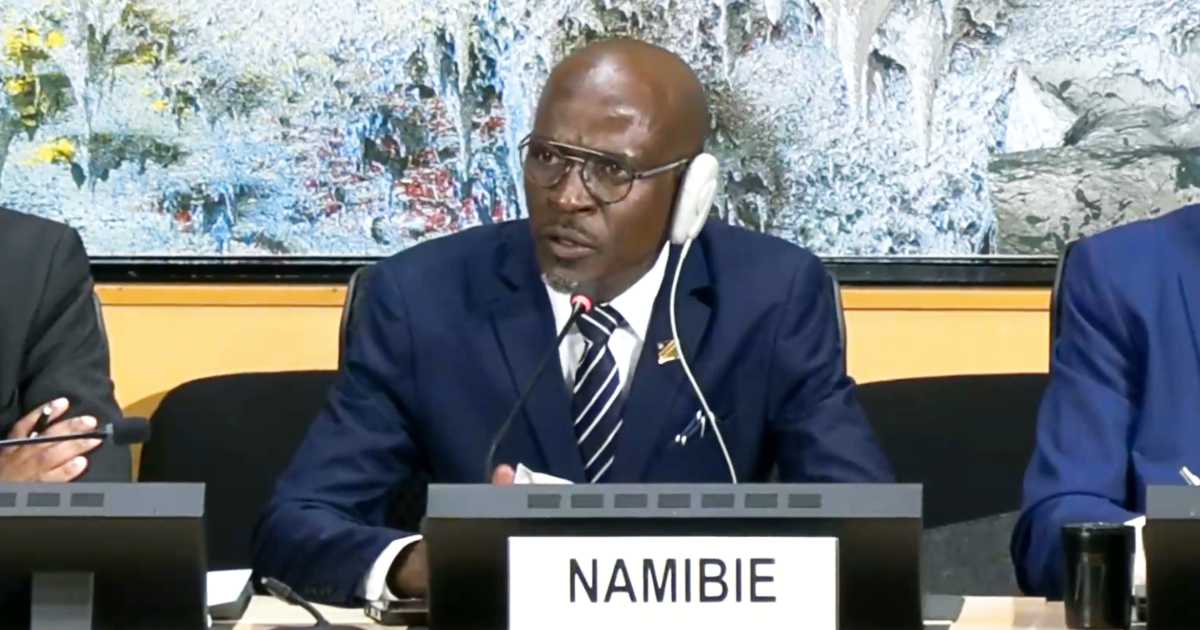
Namibia’s government has told the United Nations Human Rights Council (UNHRC) that any moves to expand LGBTIQ+ rights in the country depend on the moral convictions of its society, with officials repeatedly focusing on same-sex marriage.
On Monday, a delegation led by Minister of Justice and Labour Relations Fillemon Wise Immanuel engaged with the UNHRC on the country’s human rights record as part of its Universal Periodic Review (UPR). The UPR assesses the human rights records of UN member states every four and a half years.
Calls to Protect LGBTQ+ People from Discrimination
During the session in Geneva, member states had the opportunity to make recommendations to Namibia on how to improve its human rights protections. Several countries, including Australia, Austria, Belgium, Brazil, the UK and Uruguay, highlighted gaps in protections for the LGBTQ+ community.
These countries urged Namibia to adopt laws, policies and measures to protect LGBTQ+ people from discrimination and violence. They also called for reforms to legislation governing employment, domestic violence, rape, marriage, and civil registration and identification to ensure inclusivity.
Australia, in particular, called on Namibia to “implement the 2024 High Court decision overturning the criminalisation of same-sex relations.” In that landmark ruling, the court found that criminalising homosexuality is unconstitutional and invalid. The government has refused to accept the judgment and has appealed the decision.
Government Response Fixated on Same-Sex Marriage
Responding to the recommendations, Minister Immanuel appeared uneasy when addressing LGBTQ issues and struggled to consistently use the correct terminology. He did not directly address calls to decriminalise same-sex relations or to introduce anti-discrimination protections.
Instead, he focused largely on same-sex marriage, despite it not being central to most of the recommendations.
He told delegates that same-sex marriage remains “a hot debate back home”. While some sectors of society support marriage equality, he said, “other members of society believe otherwise, arguing strongly that it’s an issue that must be measured against the moral conviction of the society, against the cultural context of the society, and against the societal belief that has guided Namibia over a period of time.”
“For those reasons alone, the position of government is that we shouldn’t settle this specific question in a rush, but there must be thorough consultation to make sure that eventually it leaves the Namibian nation standing.”
Immanuel added that Namibia asks those with an interest in its domestic affairs to respect the need for “thorough and extensive consultation insofar as the issue of the same sex marriage or the the [LGBTQ+] issue is concerned.”
“The Elephant in the Room”
Following a second round of recommendations, Immanuel again returned to the issue of same sex marriage, describing it as the “elephant in the room that we must address, because it keeps coming up…”
He clarified that a 2023 Supreme Court ruling, which required Namibia to recognise same-sex marriages conducted in countries where they are legal, did not make same-sex marriage legal within Namibia itself.
Immanuel did not mention that the government enacted legislation in 2025, criticised by some as violating the rule of law, to nullify the Supreme Court decision and explicitly ban any form of marriage equality in the country.
The minister went on to assert that “we all know that there is no universally recognised fundamental right to same sex marriage…. Even in the West, the international human rights instruments, including those that are governed by the UN, none of them has explicitly guarantee the right to same sex marriage.”
He further argued that universally recognised rights such as equality, dignity and non-discrimination are “subject to interpretation” and depend on a country’s constitutional framework and judicial guidance.
Calls for Gradual Reform
In closing, the minister told the UNHRC that Namibia should be allowed to move “gradually” on these issues.
He said that if the country chooses to move “in a particular direction”, it must do so through consultation and that reform may be delayed to balance competing interests.
Despite the 2024 High Court ruling, laws criminalising consensual “sodomy” between men remain on Namibia’s statute books while the government’s appeal continues.
Activists have documented at least 64 arrests under these laws between 2003 and 2019. However, authorities did not ultimately prosecute these cases.





2 Comments
Minister of Justice was factually wrong about the issue of same sex conduct and same sex marriage as well as the judiciary and legislative processes and actions around it. Reducing it to a moral issue is embarrassing and deflecting. State sanctioned homophobia. Also just learn to use the terminology right, start with basics.
I wonder what their response would be to someone using that same argument for something like slavery