

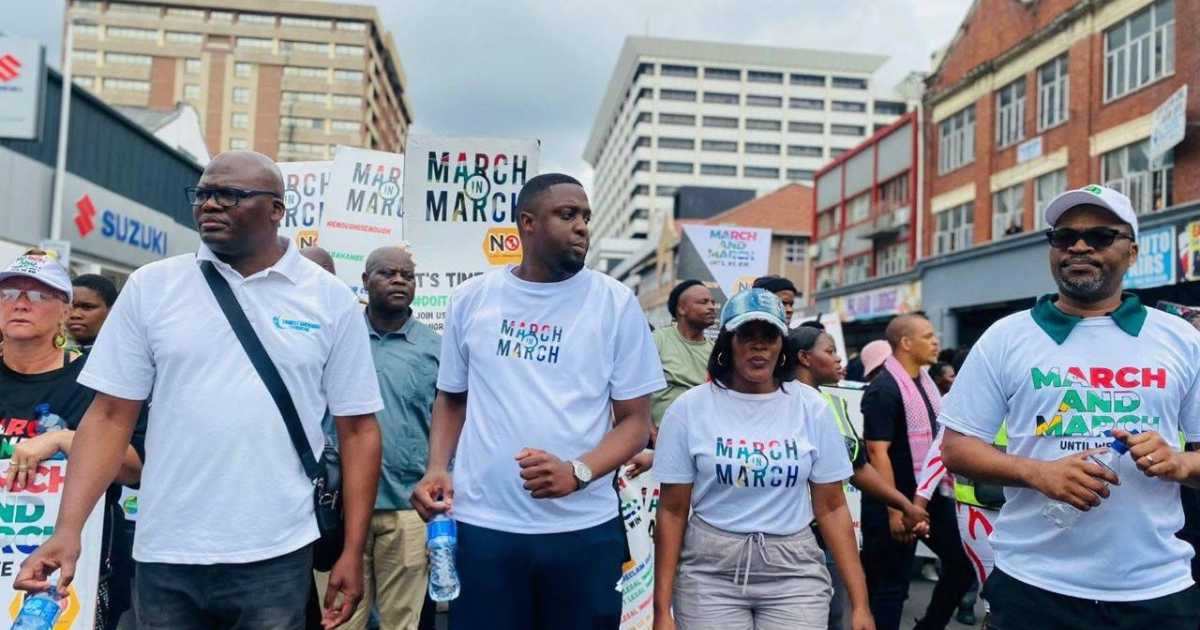
This opinion piece was written by human rights defender Sikhander Coopoo and Ugandan transgender asylum seeker Mandy Jovial, following the ongoing protests and mobilisation by March and March targeting undocumented migrants in South Africa. The authors examine how anti-migrant sentiment can have particular consequences for LGBTQIA+ asylum seekers and refugees, who may face discrimination and exclusion on multiple fronts.
Most of us come out once in our lives, to family and close friends. Queer people often talk about coming out as though it happens once, and then you are free. Nobody tells you that for a queer migrant, you keep coming out, again and again, to every official, every landlord and every mob with a phone camera deciding whether you deserve to exist on this street tonight.
We are writing this for those who cannot write it themselves, because doing so would mean admitting where they slept last night and who they slept next to. Right now, neither is necessarily safe to say out loud.
One of us lives this reality. The other watches and refuses to look away. We write as a transgender asylum seeker and a queer South African because the line between who is protected and who is not runs straight through our friendship.
When the Last Door Starts Closing
South Africa was supposed to be the exception: an African country whose Constitution names sexual orientation as a protected category, where who you love cannot be used against you. For queer people fleeing Uganda, Nigeria, Ghana and other countries where loving the wrong person can mean prison or worse, this country was the last door still open.
People come here because other places have already closed their doors.
Now we watch that door closing here too, and we want to be precise about how, because precision is the only thing standing between grief and paranoia.
March and March did not set out to target queer people. Its stated target is undocumented migrants. But movements do not always remain contained to their stated targets, and the hostility directed at migrants can have consequences for LGBTQIA+ people who are already among the most vulnerable.
Ngizwe Mchunu, who has marched alongside the movement’s founder, Jacinta Ngobese-Zuma, was found guilty by the Equality Court of hate speech, harassment and unfair discrimination against LGBTQIA+ people. That is not an accusation we are making. It is a judgment reached by a court.
Mchunu has also participated in anti-foreigner mobilisation. For us, these overlapping realities raise an urgent question: when a movement targets people based on who they are or where they come from, who is protected when that line begins to move?
Trapped in the System
And here is what March and March refuses to see: many LGBTQIA+ asylum seekers and refugees are undocumented, not by choice but because of systemic failures.
The Department of Home Affairs, including at Marabastad in Pretoria, has shown little understanding of what it means to flee persecution based on sexual orientation or gender identity, or has failed to act with the urgency such circumstances demand. Files stall. Interviews are postponed. People wait years for status that should have been processed long ago.
They are trapped in the law’s backlog, not hiding from it.
There is also no evidence that the vast majority of these people are responsible for the crimes March and March attributes to foreigners. Many are not even permitted to work. Our plea is simple: the state is failing the very people who most need its protection. This failure is not of their making.
A Double Burden of Exile
We do not say any of this to centre queer migrants over migrants who are not queer, many of whom are also being beaten, attacked and forced to flee with nothing.
Human Rights Watch has documented attacks on migrant shop owners, including the beating of a Cameroonian man during protests against foreign-owned businesses. At least two Nigerian men were also killed in Johannesburg during the same period.
We carry that grief too.
But carrying it while also carrying a second, quieter fear that the community you might run to for shelter might not want you either is its own burden. Queerness can carry a particular kind of exile within an already painful experience of displacement.
Think about what a queer refugee actually has when a mob decides tonight is the night.
A straight migrant fleeing a raid may sometimes disappear into family, into a cousin’s back room or into a congregation that will feed and hide them without asking questions. A queer migrant often has none of that.
For many, family was the first wound, back home, before the second wound of borders, language and documentation. Homophobia did not necessarily stay behind in the countries they fled. It travelled with some of the very people they fled alongside.
So when a mob comes, a clinic gate closes or a landlord decides this is the week to report foreign tenants on the street, queer migrants can find themselves facing the crisis with fewer places to turn.
When Healthcare Becomes Another Barrier
This is why healthcare gatekeeping cuts deeper than headlines usually let on.
When March and March volunteers reportedly stationed themselves outside clinics in KwaZulu-Natal and demanded identity documents, the consequences extended beyond access to malaria treatment or maternity care. For transgender people, access to hormone therapy can be essential healthcare. For others, it may mean access to HIV medication or other routine treatment that keeps them healthy.
For a trans woman, being denied healthcare can turn her body into a battlefield twice over: once against illness, and again against a system that has already made her invisible on paper.
Section 27 of the Constitution does not carve out an exception for people whose gender the Home Affairs system refuses to record correctly. Yet a person standing at a clinic gate, without legal authority to determine who deserves healthcare, can still turn that constitutional promise into something unreachable.
The Warning Signs We Cannot Ignore
We would also be careful not to claim that March and March is responsible for every act of violence against migrants or LGBTQIA+ people. No court has convicted named individuals of murdering the men who died this year, and we will not pretend otherwise. False certainty helps no one.
But there are already legal precedents that should concern anyone watching these developments.
In November 2025, the Johannesburg High Court found that Operation Dudula had engaged in intimidation, harassment, incitement to violence and hate speech based on nationality and ethnicity, and barred the organisation from demanding documents or blocking access to hospitals and schools.
The same concerns about intimidation and access to essential services do not disappear simply because a different name appears on the banner.
And Mchunu’s own conviction reminds us that hostility towards marginalised people can extend beyond nationality. When movements decide that certain people are inconvenient, unwelcome or undeserving of protection, the boundaries of exclusion can become dangerously broad.
We Cannot Turn Against One Another
We would also remind March and March that turning against foreigners runs contrary to both South Africa’s constitutional values and its history. South Africa’s people and communities have long been shaped by migration across the continent and beyond.
This is not an argument about tribe or identity. It is a reminder that accountability belongs with decision-makers and institutions, not with ordinary people turned against one another in the street.
We often think of our mothers’ words: Ubuntu, a person is a person through other people.
It is strange to hear that principle invoked in a country where some people are increasingly being made to feel that they do not count.
We Intend to Still Be Here
Queer refugees are asking for nothing exotic. They are asking to keep existing in the one place on this continent that once told them that existing was allowed.
They are asking that the clinic door stays open. That the street remains walkable after dark. That the word refugee still means something when the person asking for shelter is also holding their partner’s hand.
Nobody granted us the right to be human, and nobody standing behind a megaphone has the authority to take it away.
We were here before the marches started. Quietly and carefully, we are still finding one another in the dark when we have to.
And we intend to still be here when the marches end.
Mandy is a transgender asylum seeker. Both Mandy and Sikhander are queer human rights defenders.





One Comment
Thank you for saying this very important thing. People that fled to SA for life and death situations like being queer, should really be safe here.