

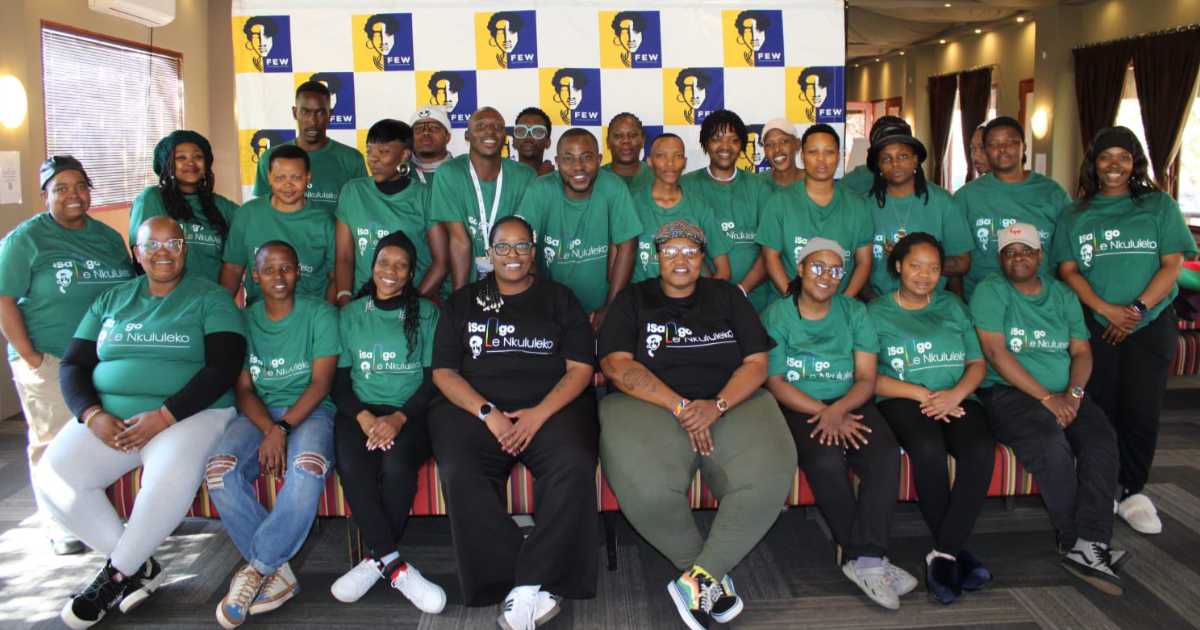
What does queer leadership look like beyond activism and crisis response? In this powerful reflection, MambaOnline Managing Editor Nompilo Gwala shares her experience of attending iSango LeNkululeko, a leadership camp focused on dialogue, learning and community-building among young queer activists.
There is something profoundly healing about gathering queer people around a fire.
Not in protest. Not in mourning. Not in survival mode. But in community. In reflection. In possibility.
That is what the iSango LeNkululeko leadership camp offered young queer activists over three transformative days. Organised in alignment with the next five years of Forum for the Empowerment of Women (FEW)’s strategy, the camp became a space for grounding, learning, healing and becoming.
The journey began with the commemoration of International Day Against Homophobia, Biphobia and Transphobia (IDAHOBIT), where participants reflected on both the progress and challenges facing LGBTIQ+ communities in South Africa and beyond.
Democracy Beyond Constitutions
The keynote address by Kutlwano Magashula, Executive Officer for Programmes at The Other Foundation, was one of the most powerful moments of the gathering. Her words challenged us to think critically about democracy, freedom and what inclusion truly means for queer people navigating everyday life.
“To interrogate democracy honestly,” she said, “we must first be willing to disrupt the comforting myths we have about it, because sometimes the most dangerous thing about democracy is not when it fails openly. It is when it performs itself so convincingly that people stop noticing who is still excluded from its promises.”
Her words landed heavily in a room filled with queer activists who know all too well the painful contradiction between constitutional rights and lived realities.
Magashula spoke directly to the illusion many democracies maintain, where rights may exist in law, but communities continue to face violence, humiliation and exclusion in their daily lives.
“It’s an illusion,” she said. “At least it is for the millions of people whose rights exist beautifully on paper, but disappear the moment they walk into a clinic, into a classroom, into a police station, a church, a workplace, or even their own homes.”
Where Democracy Truly Lives
What made her address so moving was the way she grounded democracy in ordinary human experiences rather than political theory alone.
“We’ve been taught that democracy lives in constitutions,” she said. “That it lives in elections and parliaments, in human rights commissions and the courts. But queer people know that democracy reveals itself in much smaller places.”
She continued with words that many participants will likely carry with them for a long time:
“In whether you can hold your partner’s hand in public without having to calculate the risk. In whether your teacher protects you or joins in on your humiliation. In whether you can share your pronouns, wear makeup, and rock those stilettos.”
It was a reminder that dignity is not abstract. Safety is not theoretical. Liberation is deeply personal.
Magashula also highlighted the broader political climate shaping queer existence today, warning about the rise of anti-rights movements that weaponise fear, morality and so-called family values to undermine hard-won freedoms.
Perhaps the most haunting part of her address was the question she posed to the audience:
“The question before us today is not whether democracy exists. The question is, who does it work for? Who does it protect? Who gets to feel held at the heart of it? And who’s still negotiating permission to exist?”
That question echoed throughout the camp.
Around the Fire, Beside the River
Later that evening, queer activists and young leaders gathered around a bonfire, sharing stories, laughter and vulnerability beneath the night sky.
There was something symbolic about that fire. It reflected the warmth of connection, but also the burning determination that exists within so many young queer people fighting to be seen, heard and respected.
The next morning began quietly beside the river, journaling in stillness as we reflected on our inner thoughts, our fears, our joy and the type of leaders we aspire to become.
In a world that constantly demands performance and resilience from queer people, moments like these feel radical. We are rarely given opportunities to simply pause and listen to ourselves.
Reclaiming Feminism Through Knowledge
Throughout the camp, participants engaged deeply with themes of democracy, human rights, feminist leadership and community organising. These were deeply personal discussions rooted in lived realities.
One of the most impactful sessions, for me, focused on feminism.
For years, feminism has been distorted online and portrayed as something divisive or anti-men. Social media has reduced a powerful liberation movement into hashtags, stereotypes and culture wars. But within that session, we returned to the heart of what feminism truly means: the belief that everyone, regardless of gender, deserves equal rights, dignity and opportunity.
Walking out of that room, I proudly called myself a feminist.
That moment reminded me of the power of knowledge and the importance of access to information. So much fear and misunderstanding exist because people are denied opportunities to learn, question and engage honestly with ideas. Spaces like iSango LeNkululeko challenge that ignorance by creating room for dialogue instead of judgement.
The Power of Queer Storytelling
The camp also focused on practical leadership skills, from advocacy and public speaking to community mobilisation. Young activists strengthened not only their understanding of LGBTIQ+ justice but also their confidence in using their voices effectively within their own communities.
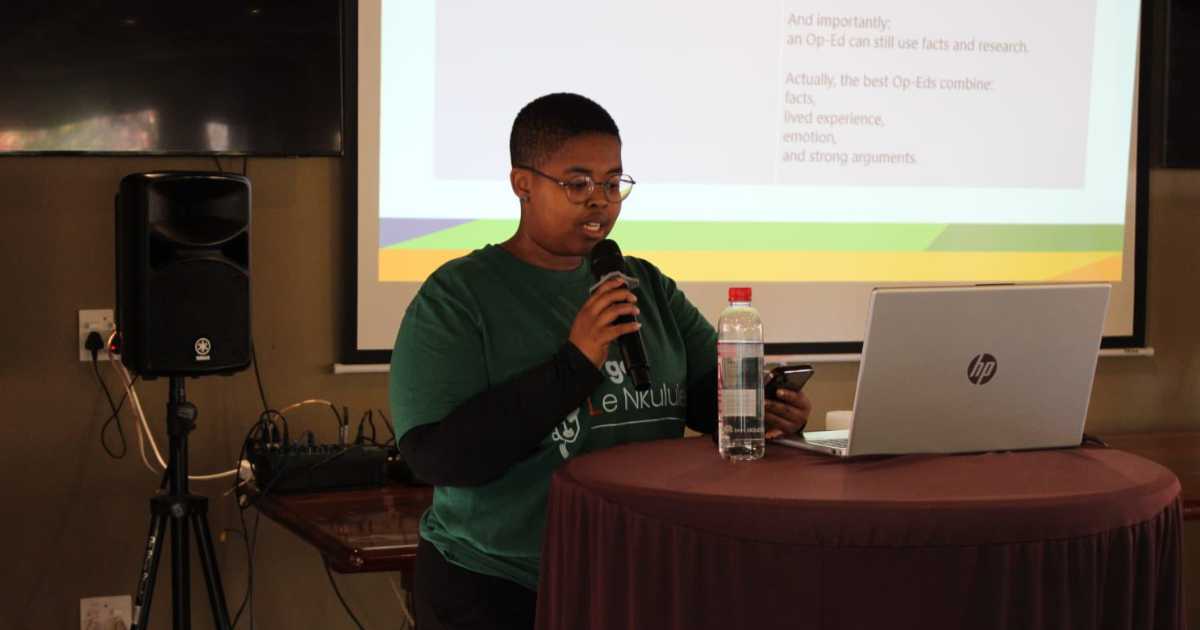
On the final day, I had the honour of facilitating a session on writing opinion articles and why queer storytelling matters.
Too often, queer people are spoken about rather than listened to. Opinion writing allows us to reclaim narrative power. It allows us to challenge harmful rhetoric, document our truths and contribute meaningfully to public discourse.
Stories shape societies.
When queer young people learn how to tell their own stories with confidence and clarity, they become more than participants in democracy. They become active architects of change.
The Fire Continues
What stayed with me most about iSango LeNkululeko was not only the workshops or discussions, but the transformation I witnessed in the participants themselves. You could see it in the way quieter voices slowly grew louder. In the way strangers became family. In the way fear slowly made room for purpose.
As participants returned home, they carried with them renewed confidence, deeper political understanding and a stronger commitment to creating change within their communities. The fire lit during those three days did not end when the camp closed.
It continues.
In every difficult conversation a young activist will now feel brave enough to start.
In every community meeting where a queer voice refuses to shrink itself.
In every article, campaign and act of resistance rooted in love, justice and dignity.
iSango LeNkululeko was a reminder that queer leadership is alive, growing and deeply necessary for the future we are trying to build.




One Comment
I’m very grateful to be part of the isango le Nkululeko Camp of 2026, I vow to always carry the fire 🔥 on with me and I will always make sure that it never dies again