

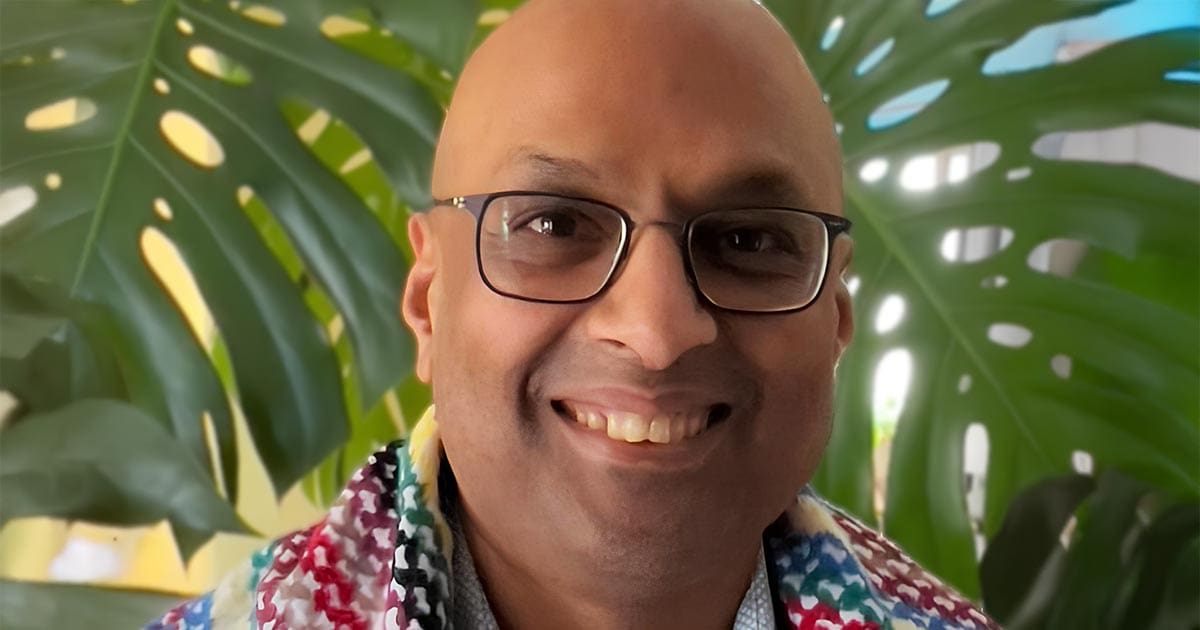
Five hundred days after the assassination of Imam Muhsin Hendricks, Sikhander Coopoo (pictured above) reflects on grief, fear and the enduring power of faith, love and resistance. In this deeply personal piece, he explores what it means to remain proudly queer and Muslim in the face of hatred and violence.
I have been trying to write this piece for days. I start. I stop. I walk away from my desk. I make tea. I go for a drive – a longer route than I used to take, through parts of the city where I am less likely to be followed. Then I come home and sit with the blank page again.
The truth is, I do not know how to write about grief and fury at the same time. I do not know how to write about love. And this is, at its heart, a piece about love, while living under threat.
500 days have passed since Imam Muhsin Hendricks was assassinated, and still no arrests. Today is also the last day of International Pride Month. Some things need to be said.
I need to start somewhere before him. I need to start with the darkness.
Finding Myself Before Finding Hope
There was a time, not so long ago, when I stood at an edge. Not a metaphorical one. A real one. Being a queer Muslim in South Africa had worn me down to something I no longer recognised. The faith community that was supposed to hold me kept telling me I was an abomination. The queer community that was supposed to embrace me kept telling me my religion was the problem. I was being pressed from both sides until there was no space left to breathe, no space left to be. I thought about ending it. I thought about it seriously.
And then came Imam Muhsin Hendricks, not in a single conversation that changed everything. It was gradual, the way seeds work. He was a man who existed fully. Openly gay, devoutly Muslim, completely himself. And that existence was a kind of teaching. I did not have to choose. I did not have to amputate part of myself to belong. He carried the pain of people like me and turned it into prayer. He planted something in me. A seed of comfort, of compassion, of permission to be whole.
The Imam Who Showed Me I Did Not Have to Choose
That seed grew. Slowly. Stubbornly. The way things grow in difficult soil.
On Saturday, 15 February 2025, I opened a video on my phone and watched Imam Hendricks be executed. Paramilitary style. In Nelson Mandela Bay. The man who had helped pull me back from the edge. Gone.
My heart broke in a way I do not have adequate language for. Within hours, social media was flooded with hate speech. Not condolences. Not grief. Hate. Directed at him, at us, at everything he stood for.
Sheikh Jameel Adams, a Cape Town cleric, published a sermon calling for the execution of homosexuals, citing scripture as his warrant. Ummati, a Johannesburg-based organisation, republished the full list of 214 people – academics, activists, professionals- who co-signed a public statement in Imam Hendricks’ defence. They published it under the heading “Beware of LGBTQ.”
The list circulated as a hit list. My name was on it.
When Grief Turned Into Fear
And then my own family said to me: “It’s Allah’s will if you get killed.” Something further inside me broke.
I want to be honest about what happened next, because I think it matters. I did not immediately harden into resolve. I fell apart. A dark and irrational guilt set in. A feeling, which I know is not rational, that I was somehow responsible for Imam Hendricks’ death.
I opened a Threat to Life case at SAPS in March 2025. I stopped going to certain parts of the city. I drove different routes. I, a Muslim man, became afraid to drive past mosques in the city where I have lived and worked for decades. There is no dramatic way to say this. It is simply what fear does to a life. It shrinks it.
And yet. In the middle of all of it, an unexpected Blessing happened. I fell in love. With the divine. With myself. With the sacred. I cannot fully explain it. I know how it sounds. But grief, when you let it move through you rather than calcify inside you, sometimes opens a door. I found myself, on the other side of the worst of it, more certain of who I am than I have ever been. I forgave myself for the guilt I carried. I was not responsible for Imam Hendricks’ murder. I am not responsible for the hatred of the people who wanted us erased. That belongs to them, not to me.
Finding Healing Through Faith, Self-Acceptance and Love
Today is the last day of Pride Month. I have always had a complicated relationship with Pride. The gay white maleness, the commercialisation, the pink-washing, the forgetting that the first Pride was a riot. An act of survival. Not only a parade. But today, 500 days in, I understand Pride differently.
Pride is what you have when they take everything else. It is what remains when the case is in limbo, and the oversight bodies have confirmed the failure, and the public institutions meant to protect you have not. Pride is not only a celebration, but it is a refusal. It is the decision, made again every morning, to still be here.
I refuse to let the 500 days since Imam Hendricks’ assassination become only a story about death, when it is also, stubbornly, a story about life. About the people who keep going. About the young queer’s somewhere in this country who do not yet know that they are allowed to exist fully, in their faith and in their body and in their love. About the seed that Imam Hendricks planted, in me and in so many others, that is still growing.
A Legacy That Hate Cannot Destroy
The architecture of this violence is not accidental. It begins long before weapons. It begins with the smirk, the eye-roll, the conversation about us that never includes us. It builds, small cut by small cut, a permission structure for harm. There is a direct line from casual homophobia to an explicit threat on my life.
The people who killed Imam Hendricks did not act in a vacuum. They were raised in a culture that told them that people like me should not exist. Heteronormativity loads the gun. Hate pulls the trigger.
The state must do its job. Those who called for our execution must be held accountable. The men who assassinated Imam Hendricks must be found and prosecuted. These are not optional. They are the minimum that justice requires.
Five hundred days. Imam Hendricks is gone, and the seed he planted is still growing. I am still here. The work is still here.
He showed me I could be both queer and Muslim. He showed me I did not have to choose between my faith and myself. In the darkness of these 500 days, light is everything. I am the light.
Sikhander Coopoo is a queer Muslim human rights defender in KuGompo City, South Africa



One Comment
I read the article and shed a tear. Your Pride, my Pride, Imam’s Pride is what’s is gonna lead to just society. You have shown me we don’t have to be defined we are born to exist the way we should. In fear of identity and still show so much love and courage. Thanks Sikhander , 500 to silence in silence,500 days to fight and 500 more until it is understood.