

2025 was a turbulent year for LGBTQ+ communities globally and in South Africa. A surge in right-wing politics placed queer people – especially transgender communities – squarely in the firing line.
Funding cuts devastated many LGBTQ+ health and human rights organisations, while multinational corporations, who previously portrayed themselves as allies, retreated from diversity commitments to appease the Trump administration.
Despite this, queer communities remained resilient. Activists, organisations and individuals continued to fight for dignity, justice and visibility, even as deep divisions persisted within the LGBTQ+ community itself.
These were MambaOnline’s most-read queer stories of 2025.
5. Grindr Gang Trial and Ongoing Attacks
The year ended without resolution to the ongoing pattern of violent attacks against queer people orchestrated through dating apps like Grindr. The most high-profile case involved seven men, dubbed the “Grindr Gang”, accused of kidnapping and brutally assaulting a Johannesburg student in September 2023.
Although the trial was scheduled to begin in February 2025, repeated delays meant proceedings only started in August. MambaOnline’s courtroom reporting detailed harrowing testimony from the survivor, his university colleague, cousin and a family friend. The survivor himself endured aggressive cross-examination. The trial is set to continue in February 2026.
Beyond this case, MambaOnline also reported on two additional Grindr-related attacks in Johannesburg, including another involving a student. Given the secrecy and shame that often surround such incidents, many more attacks likely went unreported.
4. Helen Zille’s Anti-Trans Rhetoric
Helen Zille, Chairperson of the DA’s Federal Council and a frequent source of controversy, again drew attention in April when she joined JK Rowling in applauding a UK Supreme Court ruling that excluded transgender women from the legal definition of “woman” under the Equality Act.
The regressive ruling deepened social divisions, emboldened anti-trans bigotry and undermined the safety and public participation of trans people across the UK. In a series of callous and transphobic social media posts, Zille described transgender rights as a “contagion” worse than Covid-19 and claimed they posed a threat to women’s rights. She also dismissed trans identities as “trendy”, likening them to eating disorders—arguments long discredited by medical experts and LGBTQ+ rights organisations.
Despite criticism from the ANC, trans rights groups and activists, Zille remained – as always – unmoved.
3. Controversy Surrounding Johannesburg Pride 2025
As in previous years, coverage of Pride events across South Africa attracted significant interest from readers. However, the circumstances surrounding Johannesburg Pride 2025 made it one of the year’s biggest stories.
Controversy erupted days before Africa’s largest Pride event, scheduled for 25 October, when several organisations published an open letter under the banner “NoGoBurg Pride”. The letter called for a boycott, accusing Johannesburg Pride of aligning with corporations that “profit from oppression”. It specifically named Amazon as a sponsor, alleging problematic links to Israel amid the ongoing human rights crisis in Gaza.
Johannesburg Pride’s Kaye Ally responded with counter-accusations that some of the organisations behind the letter had ties to Islamic anti-LGBTQ+ groups, claims that were denied. She also refuted the assertion that Amazon was a sponsor of the 2025 event.
Bev Ditsie, co-founder of the first Johannesburg Pride in 1990 and a supporter of the letter, organised an alternative picnic at Zoo Lake. Despite an attempt by Deputy Minister Steve Letsike to mediate, the two sides failed to reach common ground, and a cease-and-desist letter from Johannesburg Pride followed.
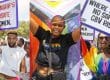
Ultimately, Johannesburg Pride drew tens of thousands of revellers celebrating in Sandton in a show of queer visibility, while the Zoo Lake picnic went ahead with a few dozen participants marking the occasion in the spirit of the early days of Pride. A contingent from NoGoBurg Pride also joined the main parade, carrying placards condemning the corporatisation of Pride and the genocide in Gaza.
2. Trump Funding Cuts: The End of an Era
The year began ominously with the 20 January inauguration of Donald Trump as President of the United States for a second term. On his first day in office, he issued a raft of executive orders, including one that sought to undermine the very existence of transgender and non-binary people by declaring that the US would recognise only two genders: male and female, defined as “an individual’s immutable biological classification”.
The Trump administration also paused all US foreign funding, including critical programmes providing lifesaving HIV services to men who have sex with men (MSM) and transgender communities in Southern Africa. Organisations were ordered to stop work immediately pending a review of all projects, abruptly cutting off access to services and medication for thousands of queer people across South Africa.
LGBTQ+ organisations were among the hardest hit. Weeks later, the funding suspensions became permanent for numerous organisations, particularly those supported through the US Agency for International Development (USAID). Retrenchments followed, while clients were left scrambling for limited alternatives to inclusive HIV, sexual health and gender-affirming care.
The repercussions continue, with reports indicating that public health clinics struggle to re-engage LGBTQ+ clients who fear stigma and discrimination. The long-term impact on South Africa’s—and the world’s—efforts to end HIV remains uncertain.
1. The Murder of Imam Muhsin Hendricks
Our most-read story of 2025 covered the brutal assassination of Imam Muhsin Hendricks on 15 February 2025 in Nelson Mandela Bay. Internationally recognised as one of the world’s few openly gay imams, Hendricks was gunned down in his car as he was about to leave a service he had officiated. The gunman fled the scene immediately afterwards.
The murder, captured on video, appeared to be a targeted killing and is widely believed to be linked to Hendricks’ visibility as a queer cleric and his advocacy for an inclusive interpretation of Islam. The attack shocked the nation and devastated his family, children, colleagues and the communities he served. President Cyril Ramaphosa also condemned the killing.
Soon after the murder, radical Cape Town imam and Islamic scholar Sheikh Jameel Adams was accused of fuelling anti-LGBTQ+ hatred by labelling Hendricks an apostate and asserting that Islam mandates death as punishment for homosexuality. Despite several hate speech complaints laid against Adams, authorities have taken no action.
Throughout the year, MambaOnline highlighted the lack of progress in the Hendricks murder investigation, with authorities refusing to provide any meaningful updates. In November, marking nine months since the assassination, Sikhander Coopoo examined the unanswered questions, investigative inertia and the lingering fear caused by the continued freedom of Hendricks’ killer or killers.
Our Other Most-Read Articles of 2025
• Queer 101: Understanding Tops and Bottoms
• Kenya: Court Orders Transgender Rights Bill After Historic Ruling
• From the Streets to the Seats: Palomino Jama on Bringing Queer Pride to Parliament
• Here Are LGBTQ-Friendly Public Health Clinics in Gauteng
• Opinion: Lasizwe’s Latest Video Is an Affront to the LGBTIQ+ Community
• Queer 101: What It Means to Be Non-Binary
• New Chapter: Safe House for LGBTIQ+ Refugees Reopens in Johannesburg
• Sitting Tall: Gay Chief Davis Mac-Iyalla’s Queer Leadership in the Heart of Ghana
• “Writing My Own Narrative”: South Africa’s First Openly Gay Male Footballer, Phuti Lekoloane
• President Ramaphosa Affirms LGBTQI+ Rights in SONA
• SAHRC Orders Ngizwe Mchunu to Retract Homophobic Remarks
• Trans History: Kewpie – The Unapologetic Icon of District Six
• Palomino Jama on Marriage Bill Hate: Equality Must Never Be Up for Debate
• History Made as Wales Elects First Lesbian Anglican Archbishop